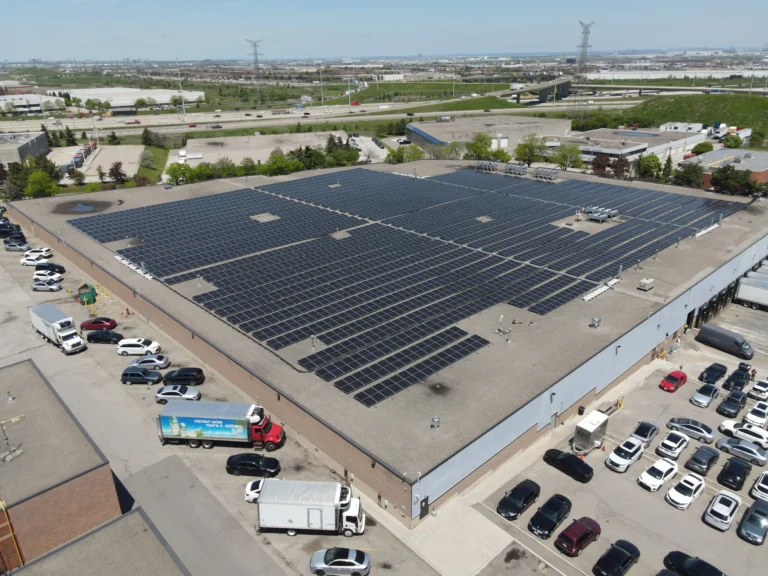

741.97 kW Manufacturing Facility Solar Project in Mississauga, Ontario
Elton Manufacturing partnered with Green Integrations to install a 741.97 kW DC rooftop solar system at its Mississauga manufacturing facility. The system generates approximately 833,995 kWh annually, offsets 37.76% of facility electricity consumption, and supports long-term electricity cost reduction through on-site renewable generation.
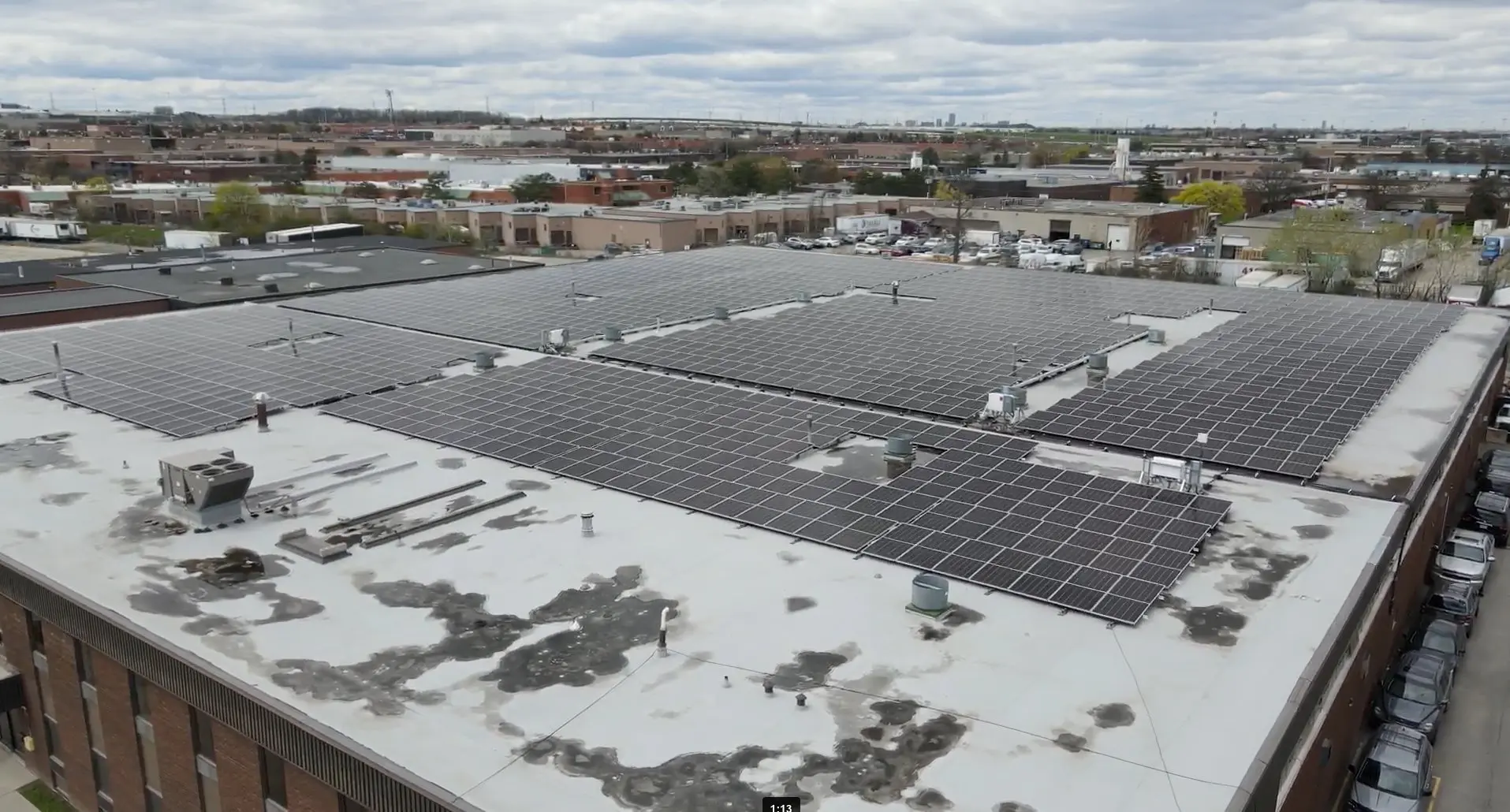
A high daytime load against a roof asset approaching the end of its replacement cycle.
Elton Manufacturing has operated from its Mississauga facility for decades, producing weatherseals, door lite frames, and garage door window components through injection molding, extrusion, and assembly. The 71,000+ square-foot building runs production equipment, compressed air systems, and climate control continuously — accumulating significant electricity costs across the year.
At that scale, grid electricity is one of the largest controllable operating expenses on the balance sheet for many manufacturing facilities. But deploying solar on a facility like this involves two real constraints that define what’s actually achievable: how much roof area is available and structurally suitable, and how much AC capacity the electrical service can accept from the utility.
Both constraints were present here. The usable roof area set the ceiling on how many modules could be installed. The available electrical service capacity set the ceiling on how much of that generation could be delivered to the building. The design objective was to maximize the system within both limits — and build as much as the site could support.
Size to the service. Mount without penetrations.
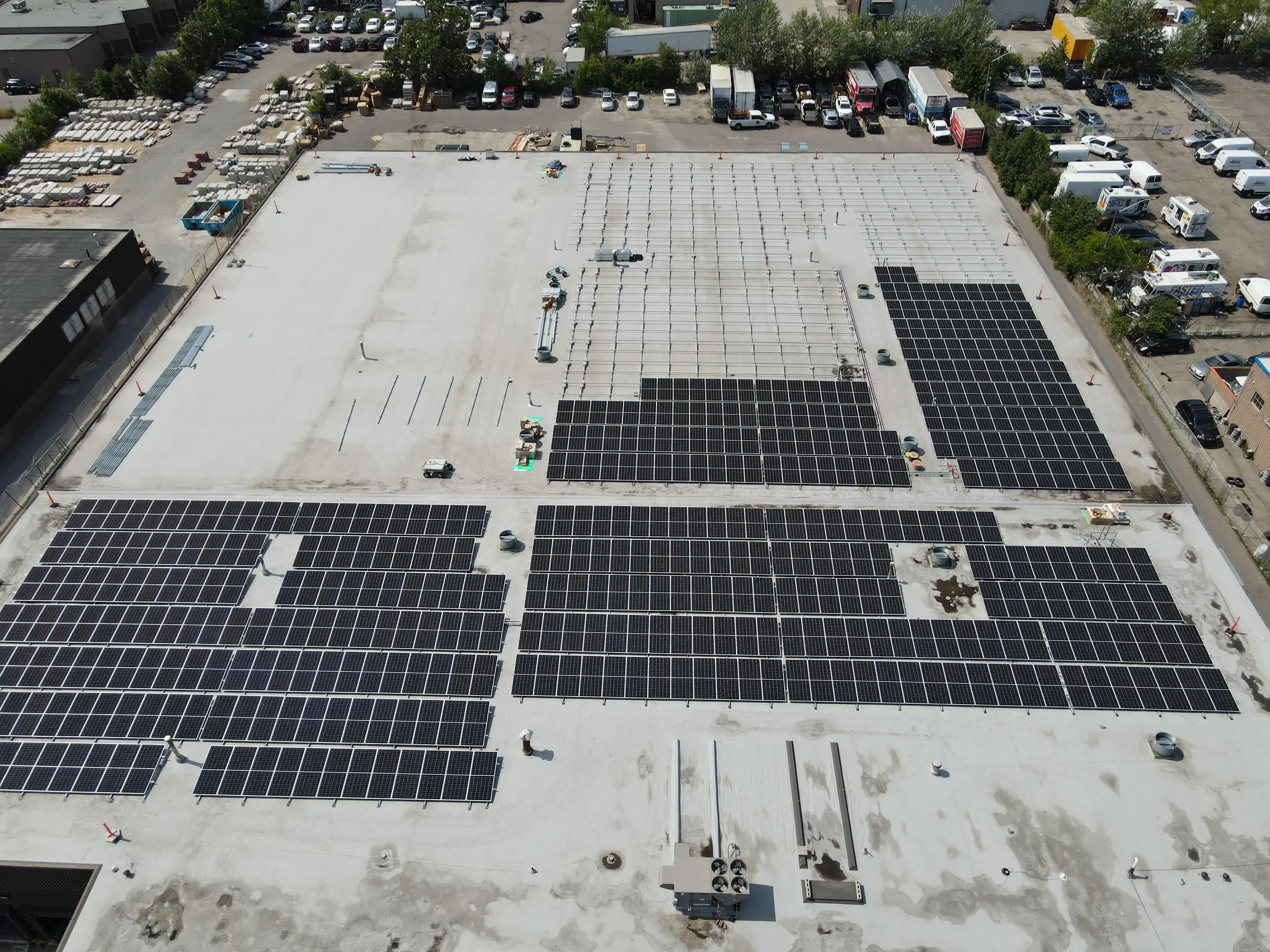
Green Integrations designed and installed a 741.97 kW DC rooftop solar system at Elton Manufacturing’s Mississauga facility — the maximum the roof could support. System layout and module count were determined by available roof area, structural characteristics, and shading analysis. The result: 1,247 JA Solar JA72D30-595 modules, each rated at 595W, mounted on TerraGen rooftop racking engineered to the existing building.
On the AC side, three Solis string inverters — two 185 kW units and one 125 kW unit — connect the array at 495 kW AC, reflecting the capacity available from the electrical service. This is a common reality on large industrial facilities: the DC array is sized to the roof, and the AC interconnection is sized to what the service will allow. Both shape the final output.
The system reached commercial operation on February 25, 2025. At 37.76% annual solar offset, it delivers a substantial and predictable reduction in grid electricity draw — displacing over 833,000 kWh per year.
The numbers, then the consequence.
- 01833,995 kWh of solar electricity generated annually — offsetting 37.76% of facility electricity consumption.
- 02741.97 kW DC installed across the full available roof area, paired with 495 kW AC at the electrical service limit.
- 031,247 JA Solar modules deployed — the maximum the roof structure could support.
- 04~52.9 tonnes of CO₂e avoided annually on the Ontario grid.
Equivalent to taking 11 internal-combustion passenger vehicles off Ontario roads.
For the facilities and engineering audience.
The system consists of 1,247 JA Solar JA72D30-595 modules rated at 595W each, for a total installed DC capacity of 741.97 kW. Three Solis string inverters — two Solis 185k-EHV-5G-US-Plus units and one Solis 125-EHV-5g-US-Plus unit — connect the array at a combined AC capacity of 495 kW, matched to the electrical service capacity available at the facility. TerraGen rooftop racking was engineered to integrate with the existing industrial roof structure as part of a broader commercial solar project. The system reached commercial operation on February 25, 2025.
The DC-to-AC ratio of approximately 1.5:1 is a deliberate design outcome of the site constraints. Array output above the inverter threshold is clipped at peak irradiance, but the oversized DC capacity improves generation during low-irradiance periods — morning, late afternoon, and overcast conditions — increasing total annual yield relative to a 1:1 configuration of the same AC size. Modeled annual output is 833,995 kWh.
The facility is located in Mississauga, Ontario, within the Toronto-area solar resource zone. Ontario’s grid emission factor of 0.0634 kg CO₂e/kWh reflects the province’s high share of nuclear and hydroelectric generation. At 833,995 kWh of annual on-site generation, the system displaces approximately 52.9 tonnes of CO₂e per year.
Facility characteristics that shaped the design.
- Injection molding, extrusion, and assembly operations running across production shifts
- Large-format industrial building with overhead crane infrastructure and high connected load
- Roof area and electrical service capacity both binding constraints on system size
- Mississauga location with strong Southern Ontario solar resource and grid interconnection access
What was installed.
Questions This Project Helps Answer
Every facility has unique operational requirements, infrastructure constraints, and business objectives. These questions highlight some of the considerations, decisions, and lessons that emerged from this project and may help other organizations evaluating similar opportunities.
- Future electricity demand should be reviewed before finalizing system size, especially for manufacturers planning equipment upgrades, added production capacity, electrification, or facility expansion. A solar system is typically designed around current and expected electricity use, available roof area, interconnection limits, and financial objectives. Oversizing can create poor economics, while undersizing may miss long-term value.
- Available roof area determines the physical upper limit of a rooftop solar system, but it is only one part of the design decision. Structural capacity, obstructions, setbacks, roof age, electrical infrastructure, and annual consumption all affect the final system. For manufacturers, roof planning should also consider future maintenance, building changes, and possible system expansion.
- Solar planning is strongest when it is connected to the facility's broader operating strategy. Manufacturers should evaluate whether electricity consumption is expected to rise, whether roof conditions are suitable over the system life, and whether the electrical service can support the desired capacity. Planning early helps avoid redesigns and improves long-term energy investment decisions.



Related Questions
Looking for more information? Explore related questions from our Knowledge Centre covering project planning, technology considerations, incentives, and operational best practices.
Evaluating rooftop solar for a commercial or industrial facility? Understanding how solar aligns with your consumption profile and long-term objectives is the first step.
- ·Roof structural and shading review
- ·Annual production model
- ·Net-Metering interconnection check
- ·Incentive & financing stack
- ·Two-scenario capital plan