Panel Soiling
Impact
2–5% recurring production loss
Dust, debris, pollen, and rooftop contaminants reduce generation efficiency over time.
Prevented withInspection + cleaning program
Commercial energy systems perform best when monitored, maintained, and optimized over time. Operations & Maintenance (O&M) services help facilities protect system performance, reduce downtime, and maximize long-term asset value.
Routine inspections, monitoring, and performance reviews help identify underperforming equipment before production losses compound over time.
Active monitoring and preventative maintenance improve response time and reduce the likelihood of extended outages or unresolved system faults.
Identifying issues early helps reduce emergency service calls, component damage, and long-term repair and replacement costs.
Regular servicing and operational oversight help inverters, electrical infrastructure, and monitoring systems operate more reliably over time.
Green Integrations provides operations and maintenance services for commercial solar systems including monitoring, preventative maintenance, diagnostics, troubleshooting, reporting, and long-term performance optimization.
Monitoring, preventative maintenance, corrective service, and performance reporting structured around the long-term operation of the asset.
Continuous system monitoring, inverter alerts, production tracking, and operational oversight to identify issues early and maintain long-term system performance.
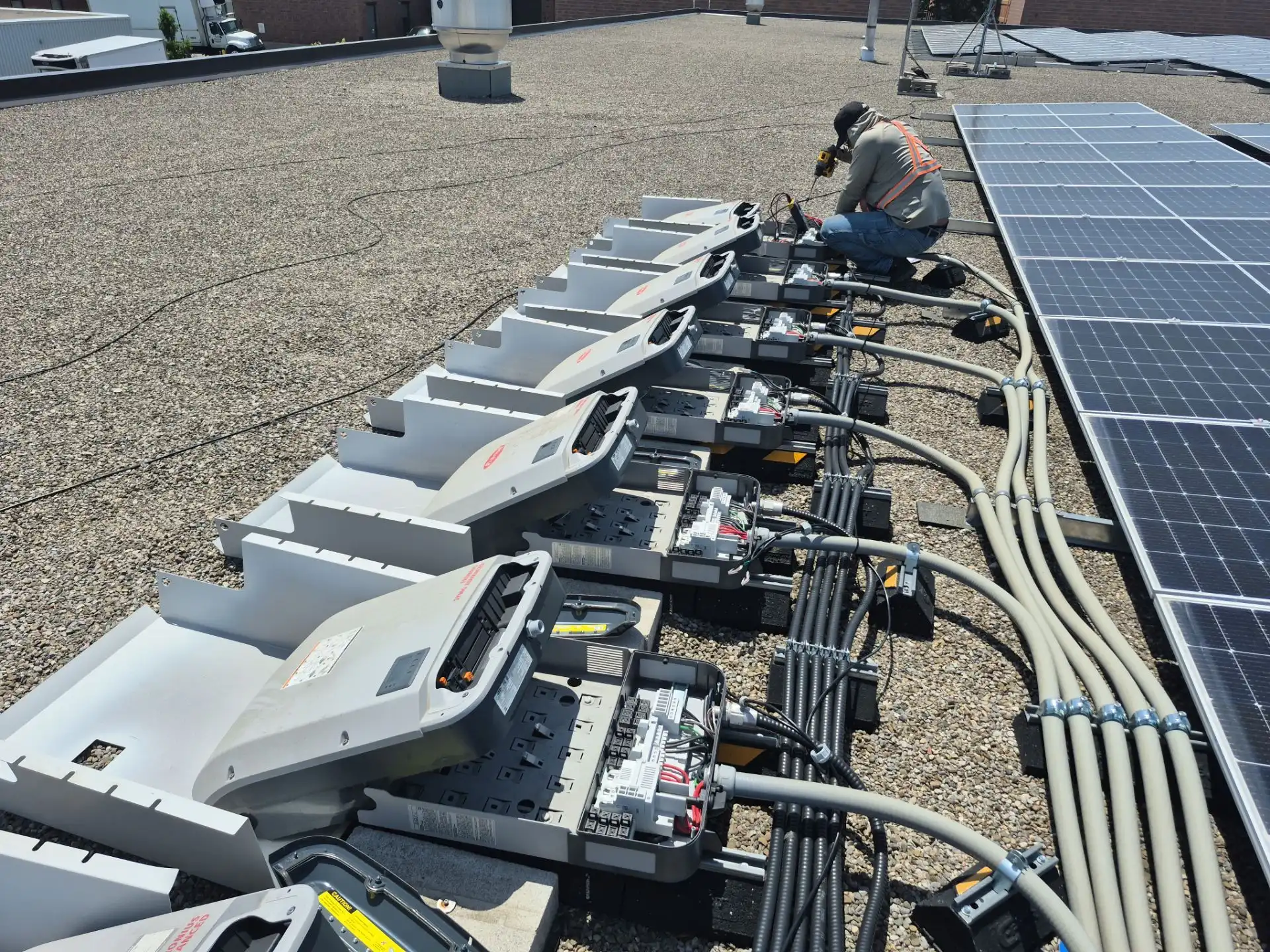
Scheduled inspections covering electrical systems, inverter operation, panel condition, mounting integrity, and general system health to reduce long-term performance loss and equipment failure risk.
Responsive troubleshooting and repair support for faults, inverter alarms, production loss events, damaged equipment, and underperforming systems.
Annual production and performance reviews benchmarked against the original financial model to identify underperformance trends, degradation risks, and future upgrade opportunities.
Commercial solar systems are financially modelled around long-term production assumptions. Ongoing operations support is not just maintenance — it is active management of system performance against the original operating model.
Annual performance reviewed against the original financial model to identify underperformance, degradation, or operational drift early.
Single operational contact responsible for inspections, reporting, maintenance coordination, and ongoing system support.
O&M services available for both GI-installed and third-party commercial solar systems.
Reliable execution and long-term service support.
Projects were completed efficiently, and ongoing support has remained strong. The team continues to deliver consistent service across multiple engagements.
Each service supports the long-term performance of your energy infrastructure, helping system owners evaluate generation, storage, electrification, and future expansion opportunities together.
Solar maintenance and O&M questions from C&I facility operators with installed systems.
For active commercial solar systems, an annual inspection is the standard minimum. Systems in environments with higher soiling risk — near construction, industrial processes, or high bird activity — benefit from bi-annual inspections. Inverter fault logs should be reviewed monthly. Most inverter manufacturers provide remote monitoring platforms that allow production data and fault alerts to be checked without a site visit.
First, confirm the underperformance by comparing actual generation against the original production model using monitoring data. A 5–10% variance is within normal range for seasonal and weather variation. A sustained gap larger than that — across multiple months or an annual total — warrants investigation. Common causes: inverter faults (identifiable from monitoring data), panel soiling or physical damage, shading from new obstructions, wiring or connection degradation, or inverter efficiency loss in older units. A site inspection typically identifies the cause within one visit.
Yes — we provide operations and maintenance services for commercial solar systems installed by other contractors. The starting point is a full system inspection to establish the current operating condition, production baseline, and any immediate maintenance or performance concerns. We work with all major commercial inverter platforms commonly used across Canadian C&I solar installations, including Fronius, SolarEdge, Solis, SMA, and others. Following the assessment, we provide a documented inspection report, identified corrective actions if required, and a forward maintenance plan structured around the long-term operation of the system.
Commercial solar systems are designed and financially modelled for a 30-year operating life. Panels are typically warranted at a minimum output level — commonly 80–85% of nameplate capacity — at year 30. Well-maintained systems operating in Ontario conditions regularly achieve this. Inverters have a shorter service life — typically 12–15 years for string inverters. Inverter replacement is a planned maintenance event within the 30-year financial model, not a system failure. Most systems will require at least one inverter replacement across their operating life. Regular inspection and proactive maintenance are what close the gap between designed lifespan and actual operating performance.
A comprehensive commercial solar inspection covers: panel condition (soiling, physical damage, delamination, and shading assessment), DC wiring and connection integrity, inverter operation and fault log review, mounting and racking condition, earthing and bonding, and production data review against the original 30-year financial model. Where a battery storage system is co-located, the inspection extends to the storage system, BMS, and interconnection.
When a string inverter approaches the end of its service life — typically 12–15 years — the options are replacement with an equivalent unit or upgrade to a current-generation inverter, which often delivers improved efficiency, better monitoring capability, and extended warranty coverage. Inverter replacement at year 12–15 is a planned maintenance item within the 30-year financial model. We assess inverter condition annually as part of the service program and provide a planned replacement recommendation before failure occurs — not in response to it. Emergency inverter replacement after failure is significantly more disruptive and costly than a scheduled replacement planned a year in advance.
Straight answers from our engineering team — explore the most-asked questions on this topic.
