Community & PartnersSolar Calculator
Green Integrations
Start your assessment

Alberta·Commercial and industrial solar

Commercial solar installation in Alberta, from Edmonton to Calgary.

Commercial solar in Alberta reduces your grid electricity consumption. Green Integrations engineers and installs commercial and industrial rooftop systems across the province. Some of our notable clients include Edmonton’s Northland Building Supplies as well as PinAcle Stainless Steel, where a 172.8 kW DC rooftop system is offsetting 90.8% of the facility’s annual electricity use. Each system is sized to your load, your electrical service and the 150 kW threshold that decides how surplus power sent to the grid is credited.

The financial model comes first, built from your own bills.

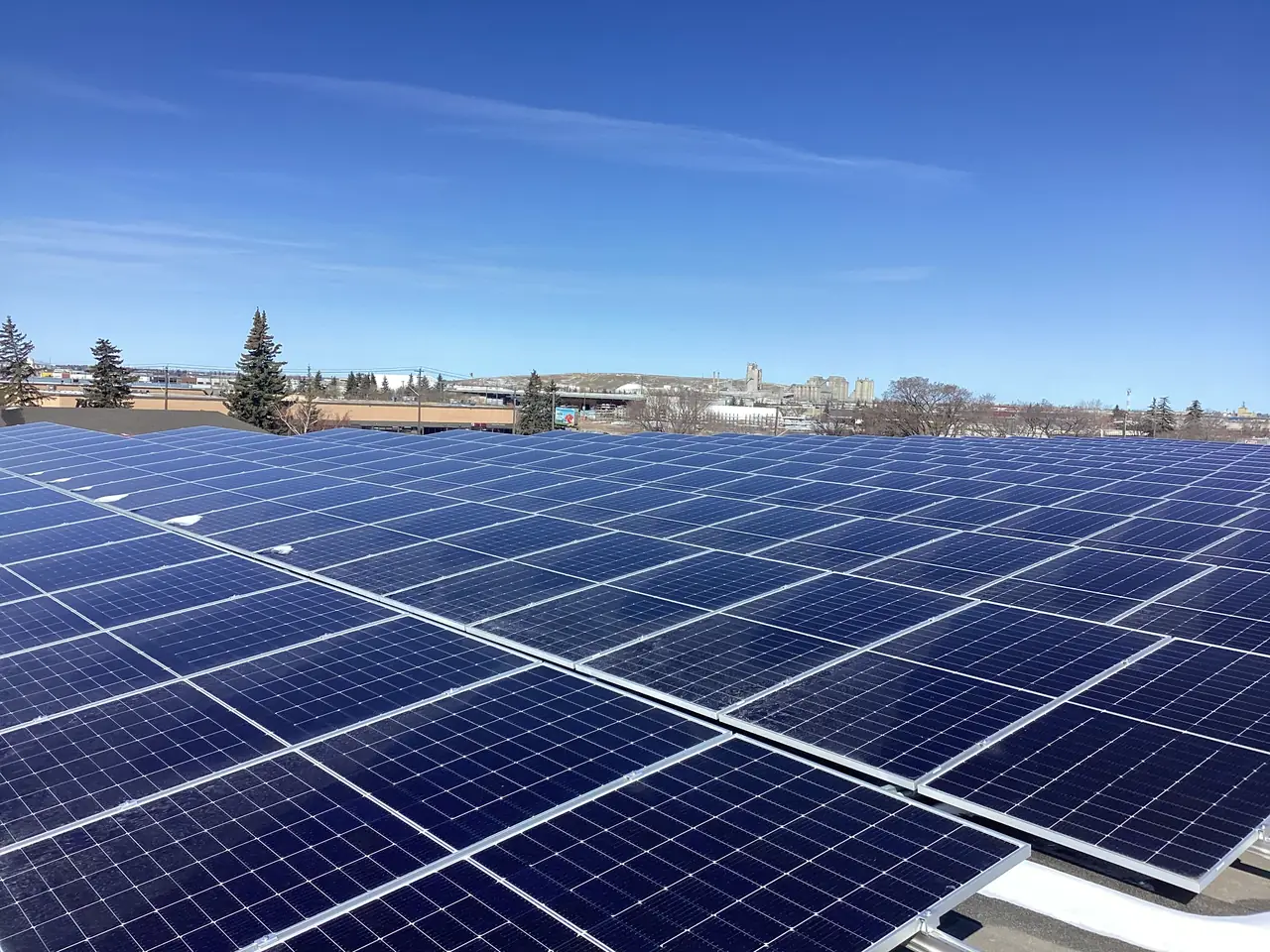
Rooftop solar array at the Northland Building Supplies facility in Edmonton, Alberta
Northland Building SuppliesEdmonton187.3 kW DC
C&I projects delivered since 2012
360+
Payback on completed projects
4.6–7.6 yr
Project IRR on completed projects
15–30%
Incentive funding secured
$20M+

Cost

Commercial solar cost in Alberta

$1.50–$2.50per watt DC, before incentives

A commercial rooftop solar project in Alberta costs about $1.5 to $2.5 per watt DC before incentives, and larger systems sit toward the lower end of that range.

A building’s roof condition, electrical upgrades and the distance from Edmonton or Calgary are factors that can decide how high or low the per watt price will be. One cost stays out of the budget: the ordinary and reasonable costs of connection and metering are shared across the distribution company’s customers, so a micro-generator does not pay them. See what commercial solar panels cost in Canada for what drives the price per watt.

Installed cost before incentives · Alberta rooftop
System size (DC)Installed cost before incentivesRange on a $0–$2.5M scale
100 kW$150,000 to $250,000
250 kW$375,000 to $625,000
500 kW$750,000 to $1,250,000
1 MW$1,500,000 to $2,500,000
  1. Market range$1.5 to $2.5 per watt DC before incentives
  2. Your buildingRoof condition, electrical upgrades and the distance from Edmonton or Calgary
  3. Connection and meteringOrdinary and reasonable costs are shared across the distribution company’s customers

Micro-generation

Micro-generation and the 150 kW threshold

Commercial systems up to 5 MW, sized to the site’s own electricity needs, can connect under Alberta’s Micro-Generation Regulation, and one system can serve adjacent sites. Alberta pays for exports through net billing, a dollar credit on your bill, and inverter capacity decides how that credit is set.

Attribute

Under 150 kW AC

150 kW AC to 5 MW

Class
Small micro-generator
Large micro-generator
Export credit
Monthly at your retail rate, or hourly wholesale with a suitable meter
Hourly wholesale market price, the pool price
Typical export value
About 5 to 15 cents per kWh at retail rates, and up to about 35 cents on a solar club plan where you qualify
About 4 cents per kWh

Under 150 kW AC

Class
Small micro-generator
Export credit
Monthly at your retail rate, or hourly wholesale with a suitable meter
Typical export value
About 5 to 15 cents per kWh at retail rates, and up to about 35 cents on a solar club plan where you qualify

150 kW AC to 5 MW

Class
Large micro-generator
Export credit
Hourly wholesale market price, the pool price
Typical export value
About 4 cents per kWh

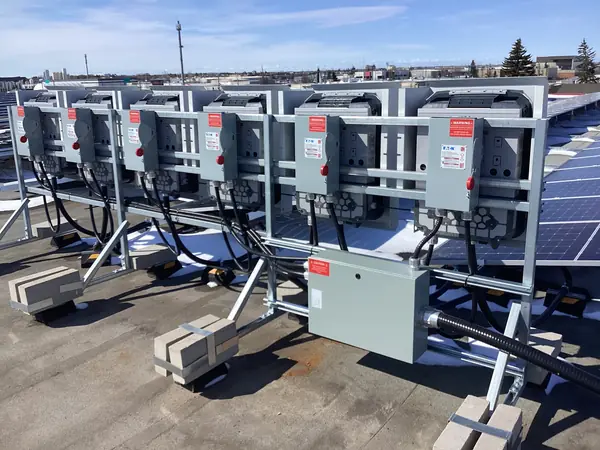
A facility that uses nearly all its output on site can go above the threshold, because exports matter less to its return. A facility with surplus summer power often does better under it. The threshold is measured in AC, the inverter capacity, so a roof can carry more DC panel capacity and stay small. For instance, Northland Building Supplies runs 187.3 kW DC on 144 kW AC of inverters.

Rooftop inverters for the 187.3 kW DC solar array at Northland Building Supplies in Edmonton, Alberta
Northland Building Supplies · Edmonton
187.3 kW DC144 kW AC · under 150

Alberta solar club plans

An Alberta solar club is a retail plan that some smaller commercial systems can join. You move to a high rate in the months you export more than you use, about April to September, and to a low rate for the rest of the year. The high rate also applies to the power you buy in those months, and the credit is agreed between you and your retailer, so we compare plan terms before the system size is final.

Incentives

Commercial solar incentives in Alberta

Federal tax measures are the primary incentive for commercial solar in Alberta, with municipal financing and a few town programs on top. There is no provincial cash rebate, since Energy Efficiency Alberta closed in April 2020.

Program information reviewed: November 2026
Federal

Clean Technology Investment Tax Credit, or ITC

Refundable tax credit
30%of eligible capital costs

Refundable credit of up to 30%.

Main conditions

Taxable Canadian corporations; the full 30% requires the prevailing wage and apprenticeship conditions; covers solar PV, battery storage and related electrical infrastructure.

Federal

Enhanced First Year Capital Cost Allowance

Tax deduction
100%first-year deduction

Deduction in the first year of operation.

Main conditions

Based on net asset cost after rebates and tax credits.

Municipal

Clean Energy Improvement Program

Property-tax financing
100%of project costs

Financing for up to 100% of project costs, repaid through the property tax bill.

Main conditions

Legal owner of an existing property in a participating municipality; work by a CEIP Qualified Contractor.

Municipal

Town of Canmore and Town of Banff

Town programs

Solar incentives for commercial property.

Main conditions

Limited yearly application windows set by each town.

Also

Industrial facilities can also look at Strategic Energy Management for Industry, administered by ERA Alberta. Every assessment includes a review of applicable funding programs, projected incentives and expected financial impact. Since the beginning of 2025 we have secured about $8.5M in approved rebates, excluding tax incentives, across Alberta, British Columbia, Nova Scotia and Ontario. Our rebates and incentives page lists the programs by province.

Worked example · federal tax credit

Example: a 180 kW rooftop system

A 180 kW DC system at $1.80 per watt and the full credit rate:

180 kW DC$1.80 / W30% ITC
Installed cost
$324,000
Clean Technology ITC30% of $324,000
−$97,200
Cost after tax credit
$226,800

Then

The first-year write-off then applies to the $226,800.

For example

197,690 kWh

For example, Northland Building Supplies, a 187.3 kW DC system, produces 197,690 kWh a year, and your model turns output like that into savings at your own rates.

Your project will be modelled using your facility’s actual data.

Check which incentives may apply to your project

Payback

Commercial solar payback in Alberta

Payback on an Alberta project depends on how much output you use on site, which export credit you secure and what you pay per kWh today. See how much a business can save for the breakdown, and your model shows the projected payback for your building.

Projects

Project examples in Alberta

Northland is a building supply facility with warehouse, yard and service functions, and PinAcle is an industrial stainless steel distributor. Both systems are on their rooftops in Edmonton and were commissioned in 2024.

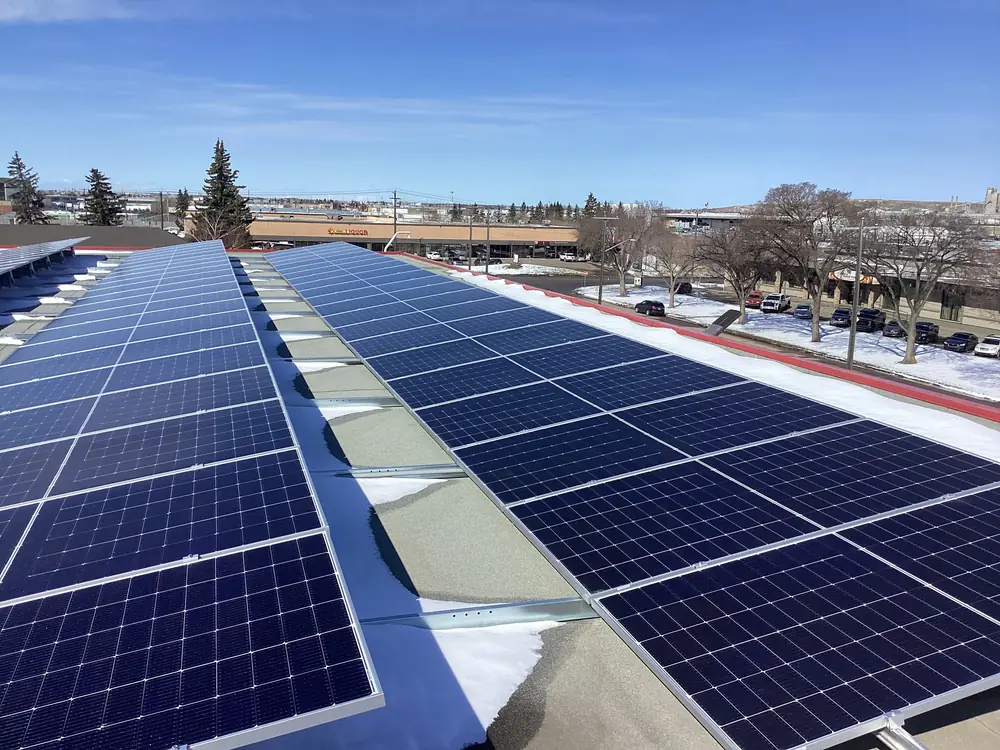
Rows of rooftop solar panels at Northland Building Supplies in Edmonton, Alberta
Edmonton · Building supply · 2024

Northland Building Supplies

System size (DC)
187.3 kW
Inverters (AC)
144 kW
Annual production
197,690 kWh
Annual electricity offset
65.2%
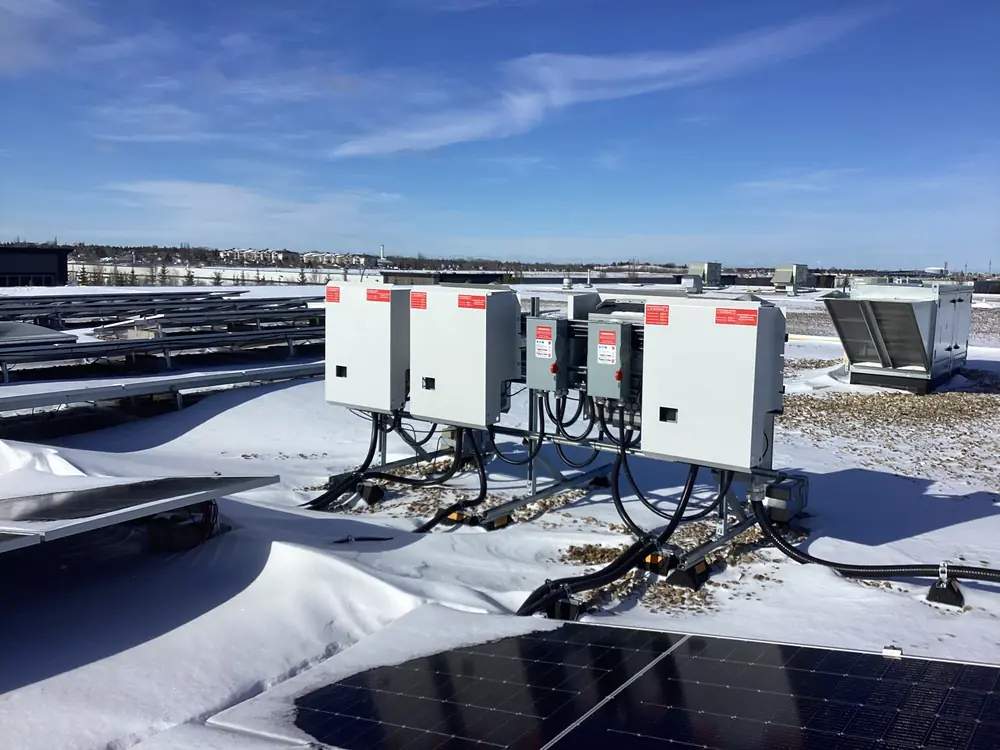
Rooftop inverters and solar array in winter at PinAcle Stainless Steel in Edmonton, Alberta
Edmonton · Stainless steel distribution · 2024

PinAcle Stainless Steel

System size (DC)
172.8 kW
Inverters (AC)
120 kW
Annual production
174,575 kWh
Annual electricity offset
90.8%

Scope 2Alberta’s relatively high grid emission factor means that each kWh of grid electricity you replace lowers your electricity-related Scope 2 emissions by more. For example, Northland’s system equals taking 24 passenger vehicles off Alberta roads each year, and PinAcle’s equals 21.

Figures shown are as published on each project page.

See all projects

Edmonton · EPCOR

Commercial solar in Edmonton

Commercial solar panels in Edmonton connect through EPCOR at most sites. Edmonton’s Commercial CEIP offers a fixed 6% rate, plus a 1.575% administration fee, for up to 20 years on existing non-residential or farm land property. A project needs at least three eligible upgrades unless fewer reach net zero, so solar usually goes in with work such as LED lighting or HVAC, and an ASHRAE Level 2 audit guides the choice. Intake is limited, so we confirm availability and the Qualified Contractor requirement before the program goes into your model.

CEIP rate
6% fixed+ 1.575% admin fee
Term
Up to 20 years

Calgary · ENMAX

Commercial solar in Calgary

Commercial solar installation in Calgary follows the same micro-generation rules, with ENMAX as the distribution company at most sites. The City offers financing here, not a solar grant. Calgary’s Commercial CEIP, launched in March 2026, covers up to 100% of project costs up to $1 million for up to 20 years, at an estimated 6.00 to 6.10%. The financing stays with the property and can be repaid early without fees.

Check your tax statement first. The property has to be labelled non-residential, and properties marked “industrial property” or “farmland” are not eligible, nor are new builds. You also need an ASHRAE Level 2 audit or a renewable energy feasibility study, and work cannot start before approval. Applications open in rounds. If your property is not eligible, the federal tax measures above still apply, and the model runs without CEIP.

CEIP rate
6.00–6.10%estimated
Coverage
Up to 100%up to $1 million, up to 20 years

Industries

Commercial solar for Alberta industries

Warehousing and distribution

Lighting, material handling and warehouse operations keep demand steady, and PinAcle’s array was sized to that consumption profile.

90.8%PinAcle Stainless Steel, Edmonton · offset

Manufacturing

A plant running through daylight hours uses most of its solar on site.

Commercial real estate

Rooftop solar can cut a building’s operating costs and supports its asset value.

Agriculture

Edmonton’s Commercial CEIP financing also covers farm land property.

Small businesses

A system under 150 kW AC is credited at retail rates, which suits a shop, office or small industrial unit.

<150 kWAC · credited at retail rates

Process

Our commercial solar installation process in Alberta

Four stages, with the micro-generation application and the utility connection built in.

  1. Bills, system size and financial model

    Your utility bills and interval data (your meter’s readings through the day) set the savings, and we set the AC capacity against the 150 kW threshold. An energy audit can show what lighting, HVAC and controls measures add to the business case, and whether they change the array size.

    Outcome
    • Financial model
    • AC set against 150 kW
  2. Engineering, permits and application

    We complete the structural and electrical engineering, municipal permits and site plan first, then submit the micro-generation application to your distribution company, such as EPCOR, ENMAX, FortisAlberta, ATCO or a rural electrification association, and to the Alberta Utilities Commission, followed by the interconnection agreement.

    Distribution companies include
    • EPCOR
    • ENMAX
    • FortisAlberta
    • ATCO
    • REAs
  3. Construction and connection

    The installation is planned around your operations. The distribution company then connects the system and its meter.

    Alberta context
    • Planned around operations
    • System + meter connected
  4. Verification and operation

    A measurement and verification report follows at 6 and 12 months, solar maintenance protects production from there, and one engineer stays with your project from audit through year 25.

    Outcome
    • M&V at 6 and 12 months
    • Same engineer to year 25

FAQs

Alberta commercial solar FAQs

Not covered here? A 20-minute call with an engineer usually answers it.

Yes, it is worth it for a facility that uses most of its output during the day and has a suitable roof. The Clean Technology ITC of up to 30% is refundable, so it is paid even where corporate tax liability is limited in the claim year, and the system can keep reducing your grid purchases for decades.

See whether your Alberta facility is a good fit

Your utility bills are enough to start. We model the system size and the projected payback for your building at no cost, and interval data then refines the result.