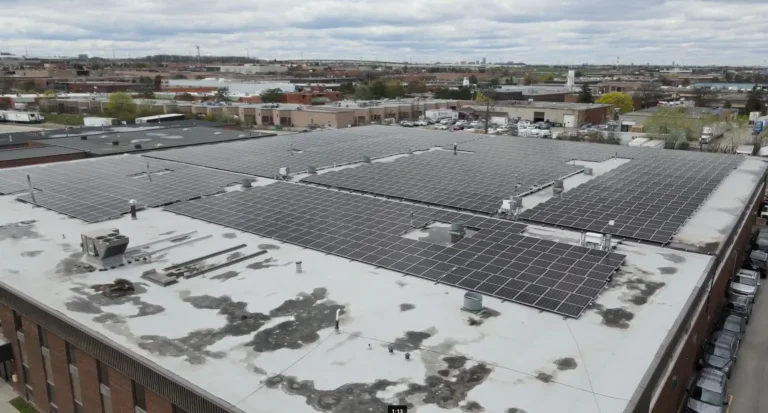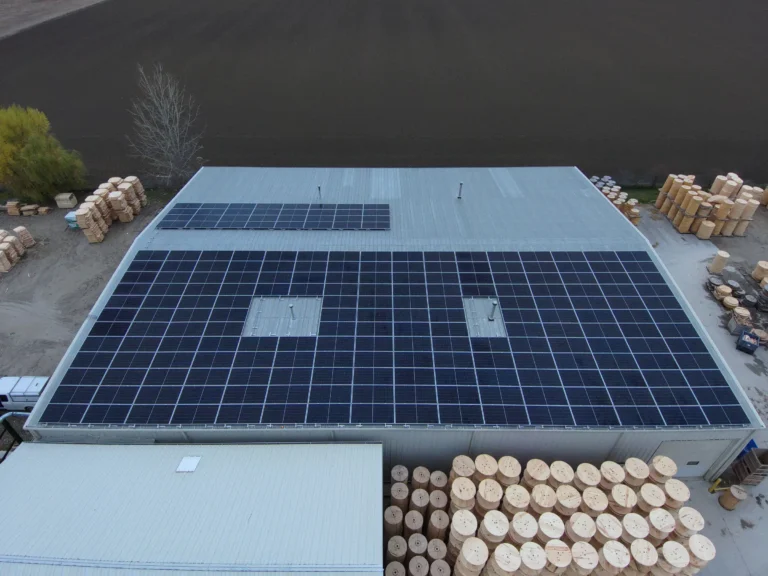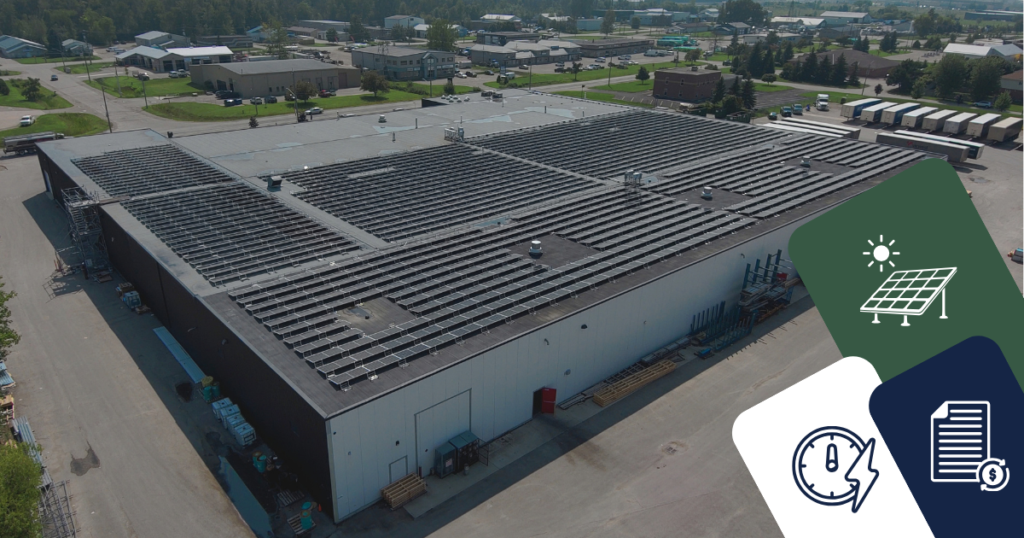


966 kW rooftop solar for a confectionery manufacturer in Newmarket, Ontario
Newmarket, ON · 2025
99.6%
Annual offset
966 kW DC
System size
Learn how much businesses can save by installing commercial solar panels. Explore the key factors that influence electricity cost savings, return on investment, and long-term financial performance.
A few years ago, most businesses were asking whether going solar was worth it. Over time, the cost-saving ability of solar power has made itself evident. Business leaders such as IKEA, Walmart, manufacturers, warehouses, food processing facilities and commercial real estate owners have installed massive solar power systems on multiple facilities. Even small businesses are rapidly choosing solar – saving substantial amounts of money in electricity bills.
Therefore, “Should we go solar?” is hardly a question businesses are asking anymore. There’s no doubt that solar saves you money. The most frequently asked question now, is “How much can we save by going solar?”
And like many other questions, the short answer to this question is “It depends”. A business can save anywhere from a few hundred to a few thousand dollars every month.
But let us go ahead and look at the longer answer, which discusses the factors that impact savings.
At the risk of stating the obvious, your savings from solar will depend on the size of your solar system. And the size of your solar system depends on your existing annual electricity consumption.
For example, consider a business that uses 500,000 kWh of electricity every year. This business installs a solar power system generating 400,000 kWh annually. The company pays $0.10/kWh for grid power. By generating its own 400,000 kWh, the business now saves $40,000 every year.
For another business that uses just a tenth of the above numbers, the savings may just be around $400 per month. Conversely, you can say that the higher your electricity consumption, particularly in manufacturing, food processing, warehousing, or commercial facilities, the more attractive commercial solar becomes.
Arguably the most important factor – your current electricity price and your savings from solar are directly proportional. By going solar, you are avoiding the bills for every kWh used. The higher the cost/kWh of your utility company, the more solar will save you.
For example, company A pays $0.10/kWh in power bills, and company B pays $0.12/kWh. If both businesses consume similar energy, and install a similar-sized solar power system, which generates 10,000 kWh of energy each month, then company A saves $1,000, while company B saves $1,200 by going solar.
An important thing to note here is the trend of grid electricity prices. Looking at just the existing price does not give a complete picture. In Canada and most places in the world, conventional power is steadily climbing. The reason for this is the costs needed to set up and maintain power infrastructure, along with other costs.
Electricity price trend in Ontario (source – OEB)
Solar power in its basic form, AKA sunlight, is free. The cost incurred in going solar is the cost of the equipment. The higher the cost of a solar power system, the lower the net savings.
Here’s a simplified example. If a system costs $300,000 and saves $1 million over its lifetime, the net savings are $700,000. But if the same system costs $400,000, the net savings come down to $600,000.
Thankfully, the costs of solar power equipment have rapidly declined in a short period. In just a decade, solar panels and other components have become over 80% cheaper.
Another thing to mention here is the quality of solar equipment. A good installer will always prefer tier-1 equipment. Thankfully, cost differences in different tier 1 manufacturers are negligible, but such equipment is more reliable in powering your business for decades without any unpleasant surprises.
Cost of different solar power technologies over the years (source – Lafayette)
Sometimes, the required size of a solar system and the available roof size do not match. For instance, a facility has a 20,000 sq. ft. roof. It can accommodate a 200 kW system but requires a 400 kW system to fully offset its grid power consumption.
In such a case, the savings will be limited to just half of the ideal savings.
The beauty of solar power lies in the fact that its benefits go beyond just bill savings. A major way solar power saves money, especially in Canada, is through reduced taxes. The federal government’s Accelerated Investment Incentive provides an enhanced first-year allowance for certain investments.
It allows businesses to write off the full cost of specified clean energy equipment, which includes solar power. As per the CCA (capital cost allowance) guidelines, businesses can save taxes on an amount equivalent to the full cost of their solar power system.
Since its invention less than a century ago, the cost of solar photovoltaics has plummeted relentlessly. Today, solar is one of the cheapest ways to use energy in nearly all places in the world, if not the cheapest.
Naturally, businesses wanting to reduce their growing electricity costs are increasingly turning to solar. And the one question most businesses have before making the decision is “how much money can solar save us?”
Solar power can reduce a significant portion of a business’ electric bills, sometimes almost entirely. Over its lifetime, going solar can save hundreds of thousands, sometimes millions in reduced power bills. This labels solar power as what it is now widely known as – one of the wisest financial decisions of our time!
Related questions covering planning, technology, and incentives.