Community & PartnersSolar Calculator
Green Integrations
Start your assessment

British Columbia·Commercial and industrial solar

Commercial solar power installation across British Columbia.

Commercial solar installation in British Columbia puts part of your facility’s electricity supply on your own roof, so you buy less from BC Hydro or FortisBC. On July 1, 2026, BC Hydro closed net metering to new customers and moved excess generation to a fixed credit of 10 cents per kWh, so the return now rests on how your generation compares with your use in each billing period, and on which BC Hydro program fits your system. Green Integrations has completed projects in British Columbia and designs and installs commercial and industrial rooftop solar and battery storage for BC facilities.

We start with your bills, so you see the modelled payback before you commit to a system.

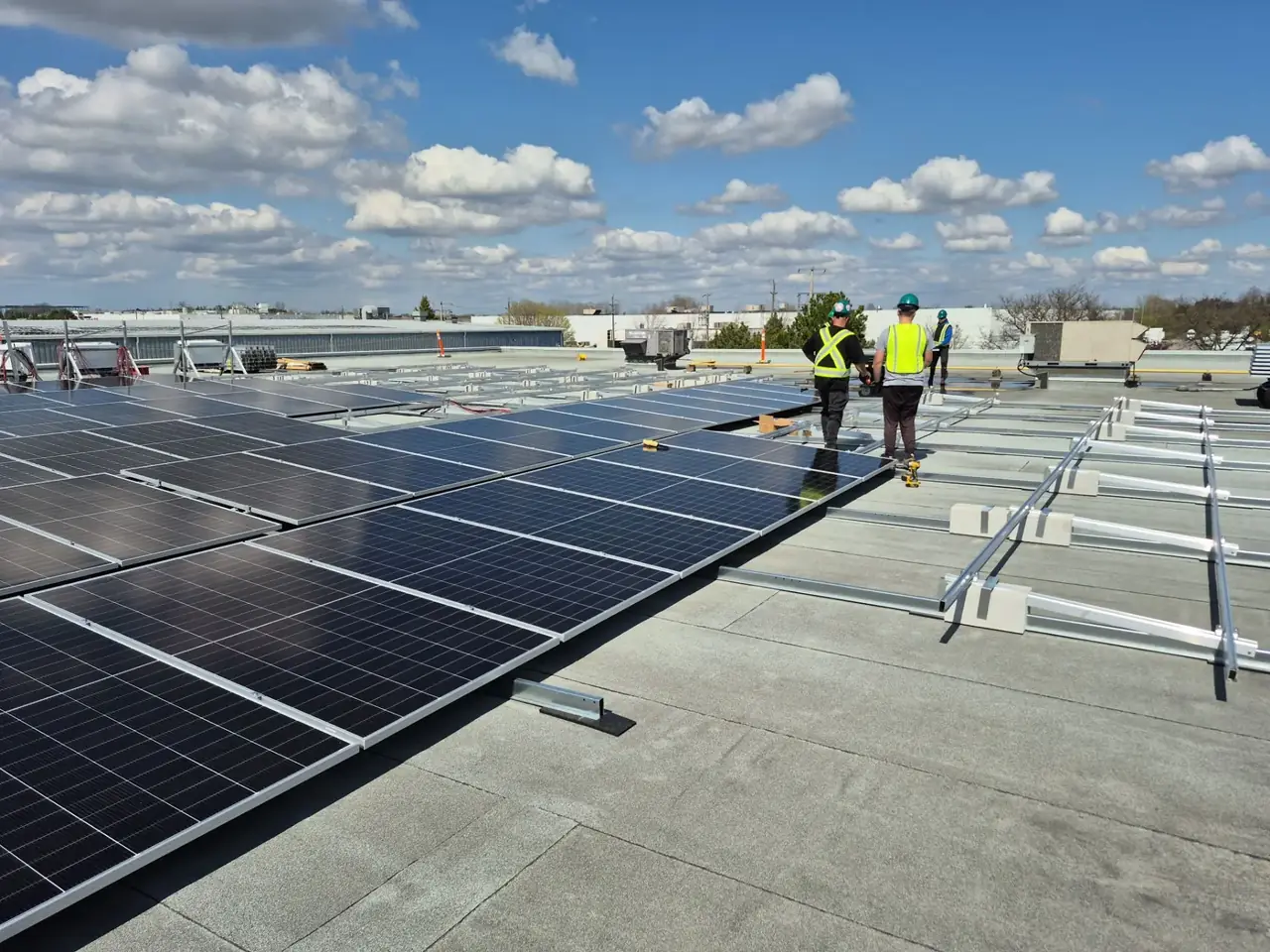
Commercial rooftop solar installation by Green Integrations
C&I projects delivered since 2012
360+
Payback on completed projects
4.6–7.6 yr
Project IRR on completed projects
15–30%
Incentive funding secured
$20M+

Cost

Commercial solar cost in BC

$1.30–$2.10per watt DC, before incentives

Installed cost for commercial rooftop solar in BC runs about $1.30 to $2.10 per watt DC before incentives, and larger systems usually land lower in that range.

Solar panels, inverters, wiring and controllers bought together as a system are exempt from BC’s 7% PST (Provincial Sales Tax), while batteries are not. If BC Hydro finds the local grid needs an upgrade to take your system, it tells you whether you fund that work, and we raise that question before the budget is final. Our guide to what commercial solar panels cost in Canada explains what drives the price per watt.

Installed cost before incentives · BC rooftop
System size (DC)Installed cost before incentivesRange on a $0–$2.1M scale
100 kW$130,000 to $210,000
250 kW$325,000 to $525,000
500 kW$650,000 to $1,050,000
1 MW$1,300,000 to $2,100,000
  1. Market range$1.30 to $2.10 per watt DC before incentives
  2. 7% PSTPanels, inverters, wiring and controllers bought as a system are exempt; batteries are not
  3. Grid upgradesBC Hydro tells you whether you fund any upgrade the local grid needs

Self-generation

BC Hydro self-generation and the 100 kW AC limit

Under BC Hydro’s self-generation service, Rate Schedule 2289, your system powers the building first. If you generate more than you use over a billing period, the difference becomes a dollar credit at 10 cents per kWh. Credit you do not use carries forward, and you can ask BC Hydro to refund it. Credits cover energy charges only, so the Basic Charge and other charges stay on your bill.

Attribute

Up to 100 kW AC

More than 100 kW AC

Who qualifies
Commercial customers on a Small, Medium or Large General Service rate
Industrial customers on a general service or transmission rate, and large commercial customers using 2 GWh or more a year company-wide
BC Hydro support
Solar rebate
Custom load displacement incentive

Up to 100 kW AC

Who qualifies
Commercial customers on a Small, Medium or Large General Service rate
BC Hydro support
Solar rebate

More than 100 kW AC

Who qualifies
Industrial customers on a general service or transmission rate, and large commercial customers using 2 GWh or more a year company-wide
BC Hydro support
Custom load displacement incentive

Load displacement means generating power on site to replace power you would otherwise buy from BC Hydro. A commercial customer using under 2 GWh a year has neither incentive available above 100 kW AC, which makes system size the first decision. The limit is measured at the inverter. Allow about 6,600 square feet of roof for every 100 kW.

100 kW AC · at the inverterAbout 6,600 sq ft of roof per 100 kW10¢ per kWh credit

Larger arrays on self-generation

A bigger system can still use self-generation if the site limits net injection, the power it sends to the grid, to 100 kW AC per phase at the point of delivery. That allows up to 300 kW of export on a balanced three-phase service. Staying inside that limit typically avoids upgrades to BC Hydro’s primary distribution system, substations and transmission system, although the secondary system and the transformer serving your site can still need work. The federal tax measures still apply to a system this size.

Incentives

BC Hydro rebates and commercial solar incentives

BC Hydro funding comes off your cost first, and the federal tax measures then apply to what is left. We have secured more than $20M in incentive funding, and our rebates and incentives page lists the programs in each province.

Program information reviewed: November 2026
BC Hydro

BC Hydro solar rebate

Rebate · per kW DC
$1,000per kW DC

Capped at 50% of installed cost and $10,000 for a commercial building.

Main conditions

100 kW AC or less; BC Hydro acceptance before equipment is bought and installed; installed by a Home Performance Contractor Network member; first come, first served while funding lasts.

BC Hydro

BC Hydro battery rebate

Rebate · per kWh of storage
$500per kWh of storage

Capped at 50% of installed cost and $10,000 for a commercial building.

Main conditions

Battery installed with a solar system and charging from solar only; the system must be non-exporting; battery-only systems do not qualify.

BC Hydro

BC Hydro Load Displacement Program

Custom incentive
75%of total project cost

Incentives covering up to 75% of total project cost, to a maximum of $1 million per site.

Main conditions

More than 100 kW AC; an eligible industrial or large commercial customer; at least 25,000 kWh displaced a year.

BC Hydro

BC Hydro Energy Storage Incentive

Incentive
80%of eligible project costs

Up to 80% of eligible project costs.

Main conditions

Qualified facilities in BC Hydro’s demand response framework, where a site reduces or shifts its use at peak times.

Federal

Clean Technology Investment Tax Credit, or ITC

Refundable tax credit
30%of capital costs

Refundable credit of up to 30% of capital costs, net of other incentives.

Main conditions

Taxable Canadian corporations; the full rate depends on the prevailing wage and apprenticeship conditions.

Federal

Enhanced First Year Capital Cost Allowance

Tax deduction
100%first-year write-off

100% write-off in the first year.

Main conditions

Applies to the net cost after rebates and tax credits.

Load displacement incentives

BC Hydro sets each incentive through its own engineering and financial review, based on up to 10 years of energy savings, and it provides funding for a feasibility study. Projects submitted by February 11, 2027 and completed by March 14, 2028 qualify for a 30% bonus incentive, so we build those dates into the schedule from the start. When Restoration Lands in Coldstream built what BC Hydro called the province’s largest commercial-industrial rooftop array, a custom incentive of almost $875,000 covered almost 40% of the installation cost.

Submit by
Feb 11, 2027
Complete by
Mar 14, 2028
Bonus incentive
30%
Worked example · solar rebate + federal tax credit

Example: a rooftop system at the 100 kW limit

A 120 kW DC system on 100 kW AC of inverters, at $1.80 per watt and the full federal credit rate:

120 kW DC100 kW AC$1.80 / W
Installed cost
$216,000
BC Hydro solar rebateAt the commercial cap
−$10,000
Clean Technology ITC30% of $206,000
−$61,800
Cost after rebate and tax credit
$144,200

Then

The first-year write-off then applies to the $144,200.

Your project will be modelled using your facility’s actual data.

Check which incentives may apply to your project

Payback

Commercial solar payback in BC

BC power is inexpensive, so payback on a BC project depends on your general service rate.

BC Hydro general service rates
BC Hydro rateAnnual peak demandEnergy chargeDemand charge
Small General ServiceUnder 35 kW14.06 cents per kWhNone
Medium General Service35 to 150 kW, and under 550,000 kWh a year10.86 cents per kWh$6.07 per kW
Large General Service150 kW or more, or over 550,000 kWh a year6.79 cents per kWh$13.83 per kW

Generation up to your use in a billing period avoids the energy charge at your rate. On Medium and Large General Service accounts, your highest 15-minute reading in each billing period sets the demand charge. Solar can bring that reading down when your peak falls in solar hours, although another peak can then set the charge, and 24-hour operations may see only a small drop. Our guide to how much a business can save covers the savings side.

Victoria · BC Hydro

Commercial solar power installation in Victoria

Commercial solar panel installation in Victoria and across southern Vancouver Island follows the BC Hydro rules above. Every photovoltaic system in the city needs an electrical permit. Under the City’s solar panel policy, a building permit is waived only on a BC Building Code Part 9 building, with loads held to 5 lb per square foot and 50 lb at each attachment point, and panels no more than 16 inches above the roof. Larger commercial buildings fall outside that waiver, so structural drawings and the building permit go into the schedule from the start.

Vancouver · BC Hydro

Commercial solar in Vancouver and the Lower Mainland

Commercial solar installation in Vancouver needs an electrical permit, and the City’s criteria send flat roofs, ballasted mounts and buildings other than one- and two-family homes to a full building permit, so industrial solar panels on a flat warehouse roof need both. The system stays off until the City Electrician accepts the installation. New Westminster runs its own electrical utility, and BC Hydro’s commercial rebate needs a BC Hydro business account, so we confirm the utility rules there before a design goes further.

Kelowna · FortisBC

Commercial solar in Kelowna and the Okanagan

Commercial solar energy in Kelowna, West Kelowna and the South Okanagan runs on FortisBC rules, as it does in the Boundary and the Kootenays, and BC Hydro’s rebates and incentives do not apply there. The FortisBC Net Metering Program is open to commercial and irrigation customers. It banks excess generation in kWh and settles any balance once a year, at the rate FortisBC pays other power producers. Capacity tops out at 50 kW and production is limited to what offsets your expected annual use. A larger system sits outside the program, and its connection terms are set with FortisBC. The federal tax measures apply either way. Coldstream, just to the north, is BC Hydro territory, so check the name on your bill first.

Storage

Solar and battery storage for BC facilities

Battery storage moves daytime solar into later hours, can trim the demand charge on Medium and Large General Service accounts, and can keep critical systems running through an outage.

Rebate trade-off

The BC Hydro battery rebate requires a non-exporting system, which gives up the 10 cent credit, so we evaluate the battery and the array together against your load profile and rate.

Industries

Commercial solar for BC industries

Manufacturing and warehousing

Industrial customers have no 2 GWh test for load displacement, and large roofs clear the 100 kW AC and 25,000 kWh thresholds easily. The first question is how BC Hydro classes your business.

No 2 GWhtest for industrial load displacement

Commercial real estate

Landlords apply with a declaration form, and the owner claims the rebate on a separate landlord form. The tenant who holds the BC Hydro account has to agree, because the rate changes and the credits land on the tenant’s bill.

Agriculture

Barns, workshops and storage buildings billed on a residential rate fall under BC Hydro’s residential rebate, capped at $5,000. We check the account type before sizing the system.

$5,000residential rebate cap

Process

Our commercial solar installation process in BC

Four stages, with the BC Hydro or FortisBC applications built in.

  1. Bills, rate class and financial model

    Your bills and interval data, the meter’s readings through the day, set the savings, the rate class and the system size, at no cost to you. Lighting, HVAC or controls savings found in an energy audit lower the load the array has to serve.

    Outcome
    • Rate class
    • Financial model
    • No cost
  2. Program and utility applications

    Up to 100 kW AC, we prepare the self-generation application with you and you submit it from your MyHydro account. A load displacement project goes through your BC Hydro Key Account Manager or Regional Energy Manager and an energy expert registered with the Alliance of Energy Professionals. Its incentive application takes about four to six weeks, and the interconnection study takes two to four months for projects of 1 MW or less.

    BC context
    • MyHydro application
    • Incentive review 4–6 weeks
    • Interconnection study 2–4 months
  3. Permits, construction and connection

    Structural and electrical engineering, building and electrical permits and the installation are planned around your operations. Your utility approves the connection once the final inspection documents are in.

    BC context
    • Building + electrical permits
    • Utility approves connection
  4. Verification and operation

    Measurement and verification reports at 6 and 12 months show how the system performs against the model, solar maintenance protects its output, and the engineer who started your project stays on it through year 25.

    Outcome
    • M&V at 6 and 12 months
    • Same engineer to year 25

FAQs

BC commercial solar FAQs

Not covered here? A 20-minute call with an engineer usually answers it.

Yes, where the rate or the funding supports it. BC power is inexpensive, so the case is strongest on Small and Medium General Service, where the energy charge is higher, and on sites that qualify for load displacement funding. On Large General Service, that funding and any demand saving carry more of the return.

Get a BC solar model built from your bills

Send us your BC Hydro or FortisBC bills. You get the system size, the program that fits and a projected payback built on your own load, at no cost.