Clear answer
Clear answer, explained.
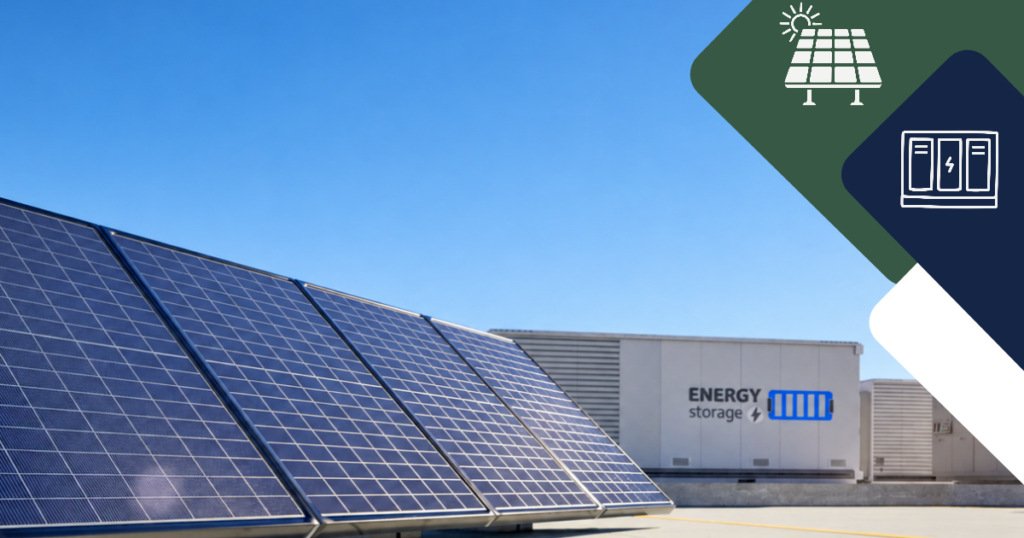
Commercial solar and battery storage are separate systems, so a business does not necessarily need to install both at the same time.
A battery can often be retrofitted to an existing solar installation, but the feasibility depends on the electrical infrastructure, inverter architecture, available space, interconnection requirements and the intended operating strategy.
If future storage is a realistic possibility, it is useful to consider it during the solar design stage.
This can include reviewing:
- Available electrical capacity
- Switchgear and transformer limitations
- Physical space for battery equipment
- Communications and controls
- Solar inverter compatibility
- Utility interconnection requirements
- Fire and safety requirements
Planning ahead does not mean installing storage before the business case supports it. It simply allows the solar project to be designed with future integration in mind.
Key points
What this means in practice.
- Battery storage does not need to be installed at the same time as commercial solar.
- Existing commercial solar systems can often be retrofitted with storage.
- Electrical capacity and system architecture should be reviewed before selecting equipment.
- Utility and interconnection requirements may change when battery storage is added.
- Leaving appropriate space and infrastructure can simplify a future retrofit.
- Businesses can install solar first and add storage later if the economics or operational need changes.
When this applies
Best-fit environments.
- Solar has a strong business case today but battery economics are not yet compelling.
- Electricity rate structures may change.
- The facility expects future load growth or electrification.
- EV charging or other high-demand equipment may be added later.
- Resilience requirements may increase in the future.
- The business wants flexibility without increasing the initial solar project scope.
Q·01