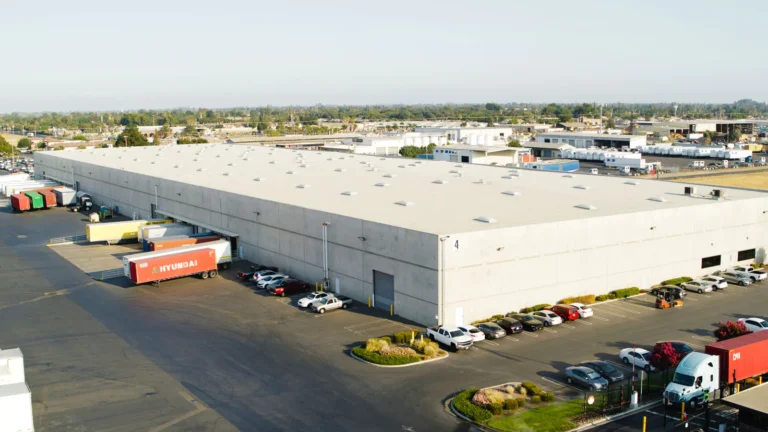
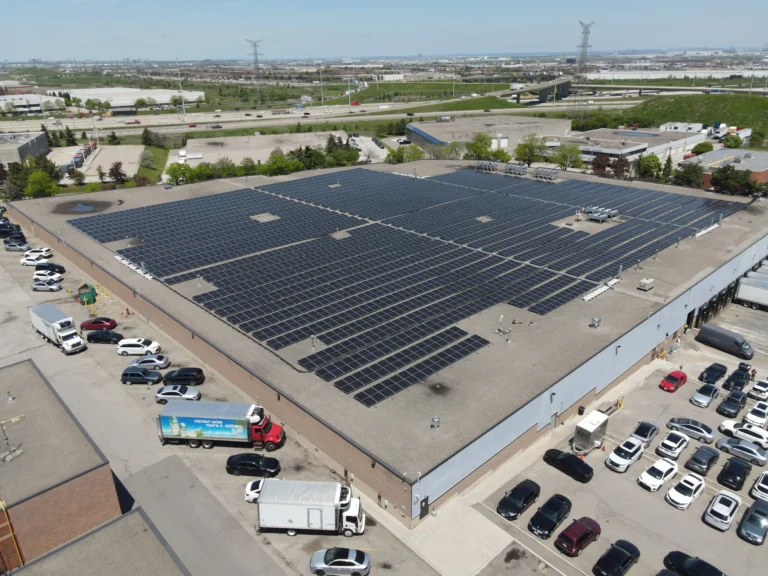
1.27 MW rooftop solar for a grocery distribution facility in Mississauga, Ontario
Coopers Drive, Mississauga, ON · 2025
67.2%
Annual offset
1271 kW DC
System size
Energy is no longer just an operating expense. Learn why Canadian businesses are incorporating energy into capital planning to reduce costs, manage risk, and improve long-term competitiveness.
For most manufacturers, capital planning is a familiar discipline. You assess aging equipment, weigh capacity expansion, factor in lead times, and build a multi-year roadmap that balances operational needs against balance sheet constraints. Energy, however, rarely gets a dedicated seat at that table.
Editor’s note: This article is part of Green Integrations’ ongoing analysis of commercial and industrial energy strategy for Canadian decision-makers.
That’s a gap that is becoming harder to justify.
Energy is no longer just an operating expense to be managed by the facilities team. For manufacturers, it is a strategic variable that affects margins, competitiveness, asset longevity, and risk exposure. Executives who treat it as a capital planning input rather than a line item on the P&L are finding real advantages. Those who don’t are beginning to experience the cost of that oversight.
Historically, energy decisions fell into one of two buckets: pay the utility bill or replace a piece of equipment when it failed. Capital budgets weren’t built around energy strategy because energy costs were relatively stable and utility infrastructure was someone else’s problem.
That model is changing. Energy prices are more volatile. Grid reliability is less certain in many regions. Regulatory pressure on carbon emissions is intensifying. And the equipment itself, compressors, HVAC systems, process chillers, lighting and motors, is aging across a large share of the industrial base.The result is that energy-related decisions are increasingly consequential and increasingly capital-intensive. They belong in the same planning conversation as a new press line or a facility expansion.
The economics of energy efficiency and on-site generation have shifted materially. LED retrofits, variable frequency drives, heat recovery systems, and solar installations can all deliver measurable ROI, often in the three-to-seven-year range, sometimes faster depending on utility rates and available incentives.
For Canadian manufacturers, the federal incentive structure meaningfully changes the financial picture. The Clean Technology Investment Tax Credit provides a 30% credit against eligible project costs, applied directly against your tax payable. Separately, qualifying clean energy equipment is eligible for 100% Capital Cost Allowance in the first year, meaning the full remaining project cost is deductible against income in year one rather than depreciated over time. When you run both through a tax filing in the year the system is commissioned, the combined effect typically offsets approximately 49% of total project costs. That is not a rebate that arrives years later or a grant requiring a separate application process. It flows through your standard year-end filing; in the year the asset goes into service.
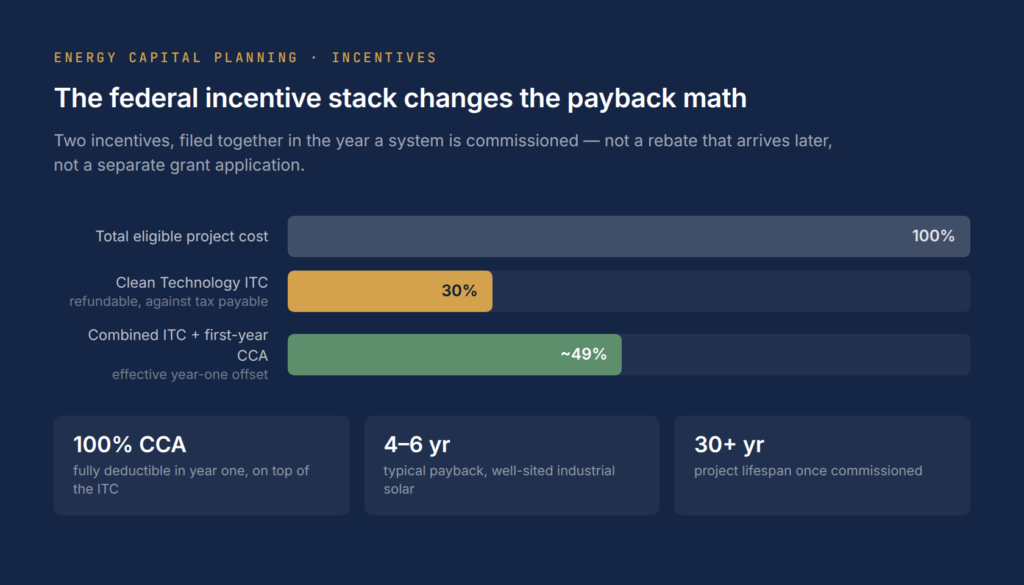
For executives evaluating projects on IRR and payback period, that first-year recovery fundamentally reshapes the math. A project that looks marginal at full cost often becomes financially compelling once the incentive effect is modelled correctly. The question is whether your capital planning process is structured to surface and evaluate these projects alongside everything else competing for budget.
There is a tension worth naming directly. In most manufacturing organizations, energy projects lose budget battles. A press line that unlocks a new customer contract, a capacity expansion that supports a key account, and an equipment replacement that is already overdue: these have visible operational stakes and clear champions. An energy efficiency project or a solar installation competes against all of it and rarely wins on urgency alone.
The instinct to defer energy investments in favour of core manufacturing CapEx is not irrational. It reflects real constraints and real priorities. But it tends to systematically undervalue what energy projects actually do.
The more useful framing is this: energy investments don’t compete with your core capital program. They extend it. A facility with lower and more predictable energy costs can run the same equipment at better margins. A facility with on-site generation and resilience capability has less exposure to the grid disruptions that halt production and erode the returns on every other capital investment you’ve made. The press line you funded last cycle performs better in a facility that isn’t absorbing volatile energy costs or sitting idle during a curtailment event.
This reframe matters practically because it changes where energy investments sit in the priority conversation. Rather than asking whether a solar project is more important than a capacity expansion, the better question is whether your capacity expansion’s projected returns are being modelled accurately without accounting for the energy cost environment that facility will operate in over the next decade.
For executives who have watched energy costs swing unpredictably over the past few years, that is not a hypothetical consideration. It is a planning assumption that is already affecting the performance of existing assets. Addressing it through capital investment is not a distraction from core manufacturing priorities. For most facilities, it is a precondition for those priorities delivering what was promised when the capital was approved.
“Energy projects shouldn’t compete with capital planning, they should become part of it.”
Manufacturers are exposed to energy risk in ways that are often underappreciated until a crisis makes them visible. Price spikes, demand charges, curtailment events, and outright grid failures can disrupt production schedules and erode margins with little warning.
Capital investments in energy resilience, backup generation, battery storage, demand response capability, or on-site renewables, are increasingly being evaluated through a risk lens rather than purely an efficiency lens. The calculus is like insurance: what is the cost of the investment relative to the cost and probability of the event it mitigates?
For facilities running continuous processes or carrying significant fixed costs per hour of downtime, this analysis often favours investment. For executives managing through supply chain uncertainty, energy resilience is one lever that is entirely within your control.
This is the lens that gets least attention in capital planning and arguably matters most over a five-to-ten-year horizon.
Energy intensity, the amount of energy consumed per unit of output, is becoming a metric that matters beyond the four walls of your facility. Customers, particularly large ones with Scope 3 emissions commitments, are beginning to require it. Export markets in Europe are pricing it through carbon border adjustment mechanisms. And as energy costs remain elevated, manufacturers with lower energy intensity simply have more pricing flexibility than those without.
Capital investments in modernizing energy-intensive processes, upgrading to more efficient equipment generations, or transitioning specific loads to electrification are not just operational decisions. They are competitive positioning decisions. The manufacturers who make them in the next three to five years will be operating with a structural cost and compliance advantage as these pressures intensify.
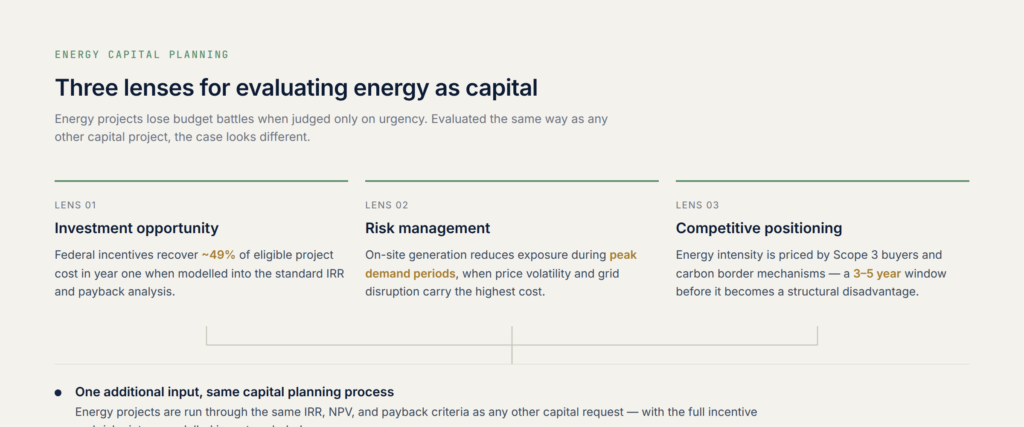
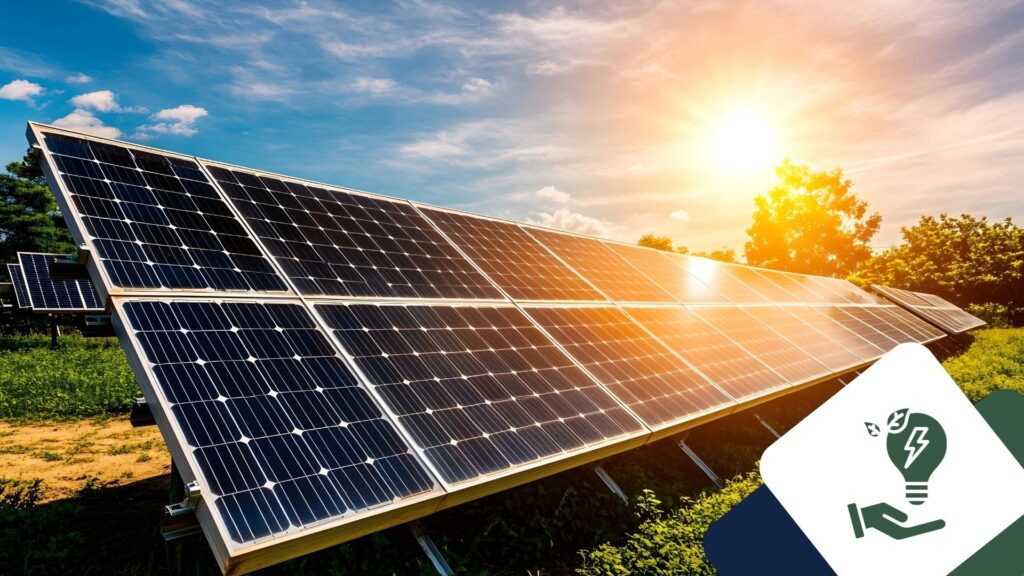
If you’re looking for a single project that illustrates all three of these lenses in practice, on-site solar is a strong candidate.It’s not the right fit for every facility or every situation. But for manufacturers with significant roof space, and meaningful daytime electricity consumption, solar has become one of the more financially straightforward energy capital investments available. Several Canadian manufacturers are already treating solar as long-term infrastructure rather than simply an electricity project.
The investment case is concrete. Installed costs for commercial and industrial solar have declined sharply over the past decade and continue to fall. Combined with federal tax incentives covering approximately 49% of project costs in year one through the ITC and first-year ACCA, the payback period for well-sited industrial installations often falls in the four-to-six-year range, with project lifespans of 30+ years. That’s a long tail of predictable, stabilized low-cost generation sitting behind a single capital decision.
The risk management case is equally real. On-site solar reduces your exposure to grid electricity prices during peak daytime hours, which is precisely when demand charges and spot rates tend to be highest for industrial users. Paired with battery storage, it can also provide a degree of resilience against short-duration outages. For manufacturers who have watched their energy bills swing unpredictably, locking in a portion of their generation at a known cost carries real value beyond the IRR calculation.
The competitive positioning case is building. Customers with Scope 3 commitments increasingly want to understand the carbon intensity of your operations. On-site renewables give you a durable, verifiable answer that purchased Renewable Energy Credits (RECs) don’t always provide. As carbon disclosure requirements expand and supply chain scrutiny grows, that distinction will matter more.
Perhaps most importantly for executives new to energy capital planning, solar is a well-understood asset class with a mature vendor ecosystem, established financing structures, and a long track record of project performance. It’s not experimental. That makes it a lower-risk entry point for organizations building the internal muscle to evaluate and execute energy capital projects.
Start here, run the analysis rigorously, and you’ll have built a framework and a team capability that transfers directly to the next project on the roadmap.
Integrating energy into capital planning doesn’t require a new process. It requires expanding the aperture of the existing one.
Energy has graduated from a cost-of-doing-business conversation to a capital strategy conversation. For Canadian manufacturers, the combination of volatile input costs, aging infrastructure, growing regulatory exposure, improving economics around efficiency and clean energy, and meaningful federal incentives available right now has made this shift unavoidable.
Executives who build energy into their capital planning frameworks, not as an afterthought, but as a structured input, will be better positioned to manage cost, reduce risk, and compete in a market where energy intensity increasingly matters.
The next capital budget shouldn’t ask whether energy deserves investment. It should ask where energy creates the greatest long-term return.
Related questions covering planning, technology, and incentives.