
How Ontario’s Changing Electricity Market Affects the Business Case for Commercial Solar?
September 28, 2026Read
As grid power becomes more dynamic, the ability to control when your facility draws electricity is as critical as how much it draws. Commercial battery storage offers this control.
As grid power becomes more dynamic, the ability to control when your facility draws electricity is as critical as how much it draws. Commercial battery storage offers this control.
But generating savings by installing a battery is more complex than it sounds. It requires a precise engineering strategy, which this article discusses in the coming sections.
A commercial Battery Energy Storage System (BESS) is a hardware + software solution that stores electricity consumed from the grid or generated on site with solar panels (or other sources). It then discharges the electricity when solar power is insufficient and/or when grid power is expensive.
Unlike traditional backup generators such as diesel engines, a BESS has software capabilities that optimize the charging times and levels of the battery to maximize savings.
At the hardware level, a BESS has a simple working principle: It draws electricity and converts it into chemical energy, which can be stored for a while. When this electricity is needed, it converts the chemical energy back into electricity through chemical reactions. However, that is only the hardware part of the equation (along with other, supporting hardware like cooling systems and PCS).
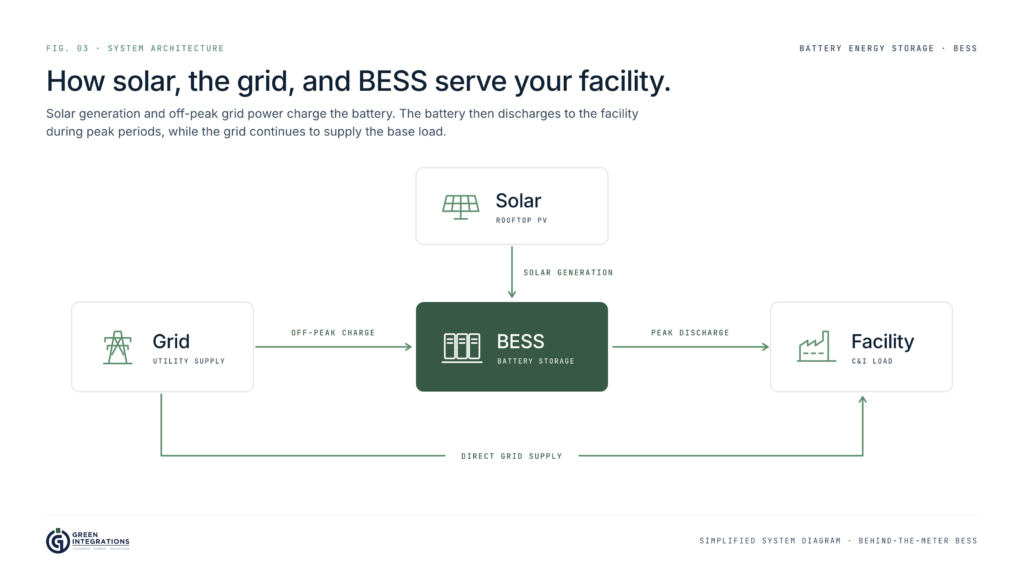
Modern BESS come with intelligent software, known as the Energy Management System (EMS). Often referred to as the brain of a battery, the EMS continuously monitors numerous parameters such as available solar power, the facility’s electrical load, and even grid pricing signals. It then uses predictive algorithms to calculate when to charge and discharge so as to offer maximum savings through solar self-consumption and peak shaving.
One of the most confused pairs of terms in electrical engineering, kW and kWh are essential specifications of any battery system. The kW (kilowatts) is a term signifying the power rating of a battery. It is analogous to how fast an athlete can sprint or how heavy weights a lifter can lift. A battery with a 200 kW rating, for instance, can power nearly 200 kW worth of machinery.
The kWh (kilowatt-hours) of a battery, on the other hand, is a term signifying the total energy storage capacity. Going back to our analogy, kWh is equivalent to how far or how long the athlete can run or how long the lifter can lift the weights. You can also think of kWh as litres in a tank and kW as the size of the hose discharging water from the tank.
A 1,000 kWh battery can power the previously mentioned 200 kW machinery for about 5 hours (200 kW x 5 h = 1,000 kWh). Note that these are theoretical figures, and efficiency losses mean the actual capacity will be lower.
When designing a BESS, there is no thumb rule that decides the kW and kWh of the battery. In fact, battery size means little without a clearly defined operating objective. For a BESS mainly designed for frequency regulation, high power rating (kW) is an important criterion. On the other hand, a BESS designed to power the facility throughout the night in the absence of solar power must focus primarily on higher kWh.
Ultimately, the specs are selected based on careful, detailed calculations of power consumption, solar power availability, and grid pricing variations.
Depending on the load profile and the applicable rate structures of a specific facility, BESS can offer one or more of the following value streams.
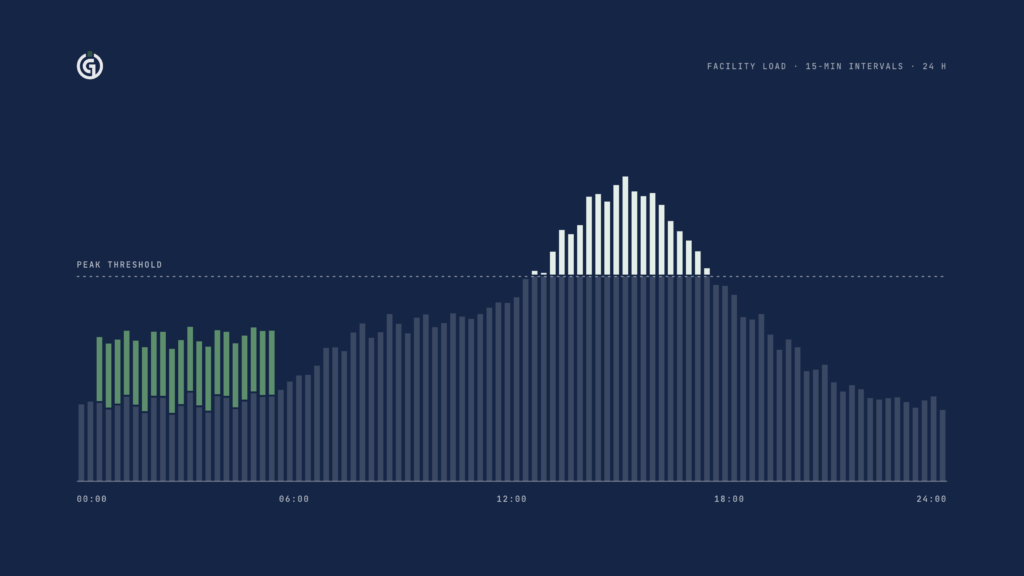
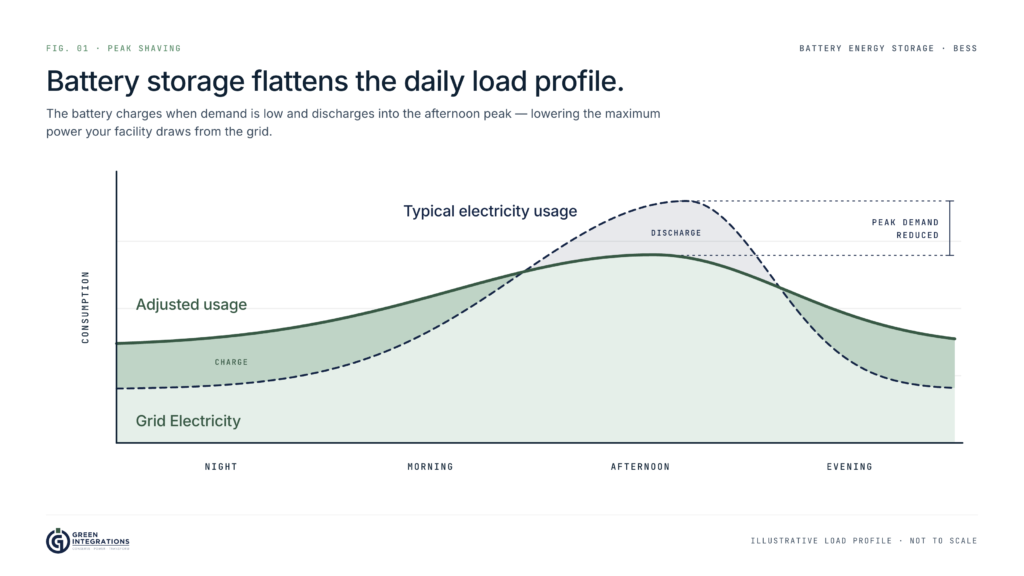
By discharging during peak demand hours, batteries can flatten daily load spikes, directly reducing peak demand charges.
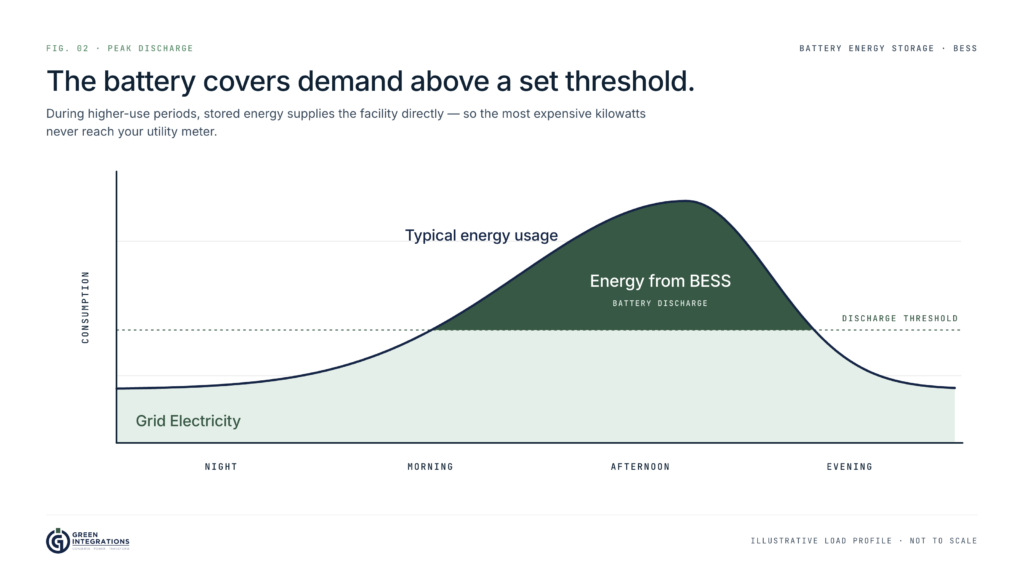
For Class A customers, BESS dramatically reduces the GA charges (under the ICI program), provided it is able to accurately forecast Ontario’s top 5 highest demand hours and discharge electricity during those hours.
For small-scale businesses that are subject to time-of-use pricing, a BESS can reduce electricity bill without reducing total kWh consumption simply by charging during cheaper, off-peak hours and discharging during more expensive, peak usage hours.
By storing excess solar energy during the day and using it during the evenings, batteries increase solar self-consumption, which can potentially produce greater savings compared to sending the excess solar electricity back into the grid (net metering).
A battery system can allow a business to participate in IESO-managed programs to dispatch stored electricity for grid stability purposes, which offers financial compensation.
BESS also performs the role of supplying operational power during grid outages, provided that the system is configured for operation during outages.
Note that a single BESS project can rarely achieve all of the above benefits. That said, the degree of impact on one or more of the above areas is more important than the number of benefits achieved.
In a less dynamic electricity market, where prices stay more or less constant, a battery has little scope to impress. The hardware works, but the economics don’t.
In Ontario, most of our electricity comes from nuclear and hydropower plants. These are baseload resources, which are expensive and inconvenient to turn off and on. This means the round-the-clock electric supply does not match the hourly variations in demand, which leads us to having peak demand charges, global adjustment, and time-of-use rates, all of which either reward us for shifting our peak load or penalize us for failing to do so. The result is a recurring gap between cheap and expensive hours.
This gap is the raw material of BESS economics. Instead of losing money because of the rate gap between cheaper and costlier hours, a commercial battery storage system turns this to the business’s benefit by charging during cheaper hours and discharging during expensive hours, offering significant bill savings.
Here in Ontario, a BESS will almost always generate some amount of savings, but whether it creates a strong business case depends on the facility and a few key factors specific to that facility. Here’s an overview:
Does the facility have notable, predictable demand peaks that a battery can successfully shave? A BESS may not make sense if a facility’s load profile is flat or has very subtle demand peaks.
Are the peak charges for your facility high enough to justify the capital expense of a battery?
How frequent are the battery’s expected charging and discharging cycles? If they are too frequent but offer little savings, the battery may degrade prematurely – before the capital cost is recovered and any net savings are achieved.
Is the battery cost recoverable in a decent timeframe, i.e. does it have a good enough payback period?
Can the EMS accurately predict peak events, especially those for elusive Class A Global Adjustment peaks? If the main goal of installing a BESS is saving on GA charges, it is essential to ensure the battery can successfully predict peaks.
Assessing if the facility qualifies for any demand response programs can help judge the battery’s financial impact better.
Getting a BESS is a big step, especially considering its sizable price tag. Before making any final decision or engaging vendors, any business should prepare/evaluate the following:
The best way to determine if a BESS makes financial sense for your facility is to work with a reliable expert to examine the viability of a commercial battery system.
Related questions covering planning, technology, and incentives.