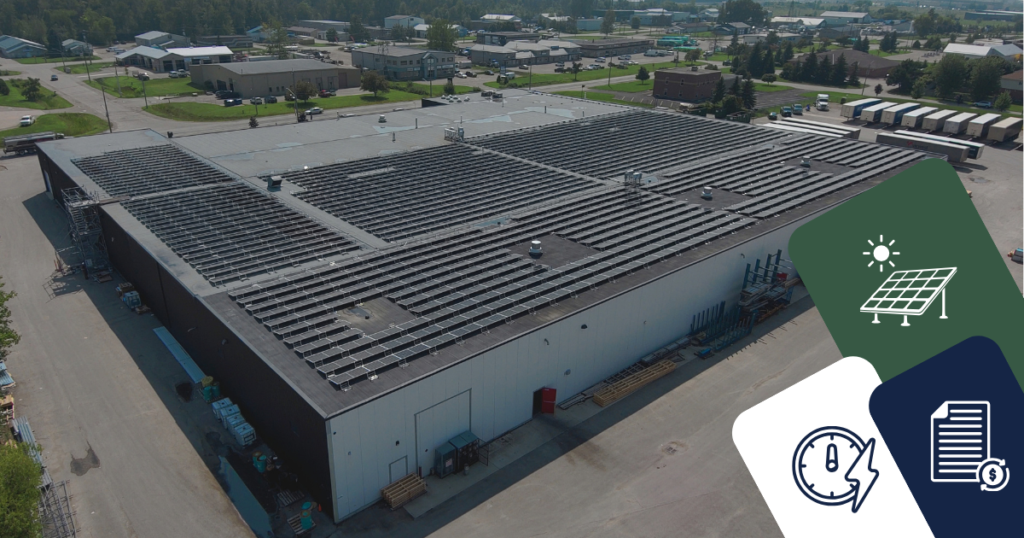

966 kW rooftop solar for a confectionery manufacturer in Newmarket, Ontario
Newmarket, ON · 2025
99.6%
Annual offset
966 kW DC
System size
Ontario’s electricity market has changed, making accurate solar modelling more important than ever. For commercial and industrial facilities, the value of onsite solar depends on when electricity is used, the applicable rate structure, and how closely solar generation aligns with the facility’s actual load profile.
The value of a kWh of solar energy is not intrinsic, and certainly not fixed. In Ontario, its value is proportional to the value of the kWh of grid electricity you didn’t have to buy at that exact moment. Historically, the value of grid electricity in Ontario was uniform across the province. Today, it is highly dynamic!
In the spring of 2025, the Independent Electricity System Operator (IESO) did something it hadn’t done for over two decades. It completely overhauled Ontario’s province-wide electricity pricing model by launching the Market Renewal Program (MRP). Now, the price of a single unit of electricity depends on the location and time it is consumed at.
This means that for a potential solar power system, you cannot calculate savings by simply multiplying an average/blended electricity rate with the projected output in kWh. Two completely similar facilities with the same size and kind of solar can still save vastly different amounts of money. To understand why, let’s begin by understanding the changes in Ontario’s electricity market.
The Market Renewal Program (MRP) brought in radical changes to how electricity was priced throughout Ontario. Of all the pillars that make up the MRP, three main pillars affect the savings from solar panels on a commercial or industrial facility.
Previously, Ontario used a uniform pricing structure province-wide – the Hourly Ontario Energy Price (HOEP). Under this system, a facility in Windsor paid roughly the same price per kWh as another one in Ottawa. Now, the MRP uses a “Locational Marginal Pricing (LMP)”, wherein locations are designated by “nodes”.
There are over 1,000 specific pricing nodes in the province, and the price at each node depends on the local supply, local demand, and transmission congestion in that location. High-level market participants like dispatchable generators, dispatchable loads, self-scheduling/intermittent suppliers and price-responsive loads are subject to the LMP.
While the LMP does not directly apply to individual end customers like commercial businesses, it does impact the overall pricing in the location to some extent.
The DAM is a financially binding wholesale marketplace where participants submit price bids one day in advance, and IESO algorithmically clears supply against forecasted demand to secure cost-effective power. For end customers, this means that the electricity prices for every hour in every location are fixed before the sun rises on that day.
The earlier-mentioned LMP applies to high-level market participants like generators and intertie traders. For large end customers like C&I facilities, the Ontario Electricity Market Price (OEMP) comes into play. It is a combination of the Day-Ahead Zonal Price (DA-OZP – a subset of the DAM that allots a different kWh rate to every hour and zone) and a correction factor called LFDA.
All of this may sound a bit confusing – simply remember that the OEMP results in notably different pricing throughout the province and throughout the day based on demand-supply and congestion.
All these above concepts are designed to bring an extreme level of specificity and accuracy to the electricity prices. No longer can we expect to have uniform and steady pricing throughout Ontario, which means we can no longer predict returns from a solar panel system without closely understanding a facility’s electricity consumption patterns.
Since electricity price at a location now changes throughout the day, the savings from solar will strongly depend on how closely the hours of solar production match the hours of high electricity price. Here’s a graph that explains this better.
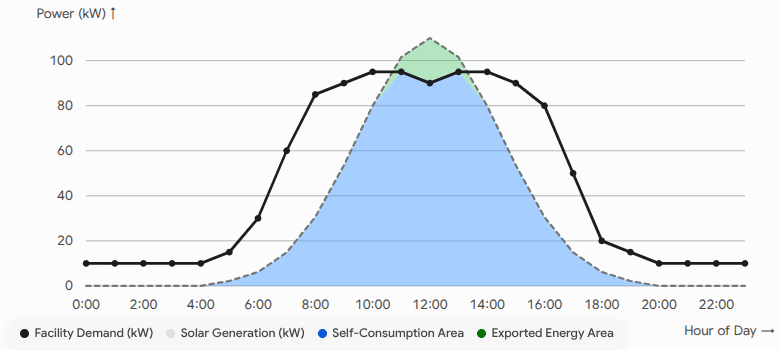
The above graph shows the electricity profiles in a typical commercial facility. Let us suppose that the system is designed to offset the majority of the facility’s electricity usage. For the highest possible savings, the electricity rate when the facility is consuming maximum solar power should be high. Similarly, the rate when the gap between demand and generation is the highest (around 8 am and 5 pm in this graph) should be the lowest.
This would ensure that when the facility draws more grid power, it spends less money on it, and that the grid power rate only peaks when the facility avoids grid power. In reality, it is difficult to achieve such a perfectly ideal pattern because both solar production and grid pricing are not in our hands. Additionally, there’s a daunting concept that may make even an otherwise ideal profile pointless – the GA!
A commercial or industrial facility’s electricity bill in Ontario is quite complex. It includes numerous things beside the rate per kWh. Especially for Class A customers, Global Adjustment (GA) is a major part of the bill.
A facility’s GA is calculated by considering the facility’s energy usage during Ontario’s top five highest demand hours. This means that if the highest demand occurs at 5 pm in January, solar is not going to put a dent in the GA portion of their bill.
If every kWh a facility used in a year was priced equally, the annual kWh figure would have been a truly helpful number, offering a precise savings value through simple division and multiplication. However, as we’ve discussed earlier, the electricity bill of a business is highly complex.
A typical facility bill includes multiple charges that may or may not depend on the number of kWh used. Additionally, even when we ignore other charges for a moment and simply look at just the kWh charge, we will see a changing rate based on the time of day.
This is exactly why the actual financial modelling of a project should undertake a fairly complex set of calculations, which involves first looking at the facility’s load profiles and the changing rates of its electricity. In short, don’t fall for the “blended rate” trap.
A typical grid-tied solar power system on any business is configured in a way that the facility uses the generated solar energy first and only draws power from the grid when solar is insufficient.
Since grid power pricing is notably volatile, a solar panel system acts as a hedge against the uncertainty of grid power pricing. During the day, when solar power is available, the facility is less susceptible to the volatility of pricing.
As a side note, adding a battery storage system can further reduce the effects of grid pricing uncertainty. It does so by stepping in when solar power is unavailable to power some of the facility’s loads during peak usage hours.
No. IESO designed the Market Renewal Program to bring precision in the pricing mechanism. It does not take into account solar power in any way.
For any commercial or industrial facility, solar project economics are highly facility-specific. They depend entirely on how, when, and how much electricity the facility consumes, and where the facility is located.
For instance, a facility located in a congested zone with high Locational Marginal Pricing (LMP) and demand that coincides with high demand hours, solar is highly valuable, as it displaces costly grid electricity. On the contrary, for a facility in a zone with excess generation and low LMP, solar may turn out to be less economically attractive than it was in the HOEP era, making the sizable cost of a system unjustifiable.
In simpler times, it was enough for businesses to consider their annual usage and the average electricity rate to decide if going solar was worth it. Now, a business must work with an installer to consider multiple things to figure out if solar is a useful investment. Below is a list of the same things:
If you are wondering if solar is a good fit for your facility, talk to us and we can analyze how onsite solar fits your facility’s electricity profile and long-term energy costs.
Related questions covering planning, technology, and incentives.