


Community & PartnersSolar Calculator
Green Integrations
Start your assessment
InsightsMarket & TechnologyIs Canada Entering a New Solar Era? Lower Costs and…
Market & Technology2 min read

Is Canada Entering a New Solar Era? Lower Costs and Policy Support Driving Adoption

A look at Canada’s growing solar energy sector, the trends driving adoption across regions and markets, and what this growth means for clean power, grid resilience and future energy planning.

Is Canada Entering a New Solar Era? Lower Costs and Policy Support Driving Adoption

2013 was perhaps the first milestone for Canada’s solar energy sector. The cumulative installed capacity reached 1 GW in 2013. Since the introduction of commercial solar, somewhere in the 1980s, reaching the first gigawatt took about 3 decades. Interestingly, the next gigawatt was added in only 2 years, in 2015! The graph of solar’s growth in Canada has been, like anywhere else in the world, consistently upward.

What has caused this change? Have a look at the following graph, one that’s probably the most comprehensive on the past and present of solar energy:
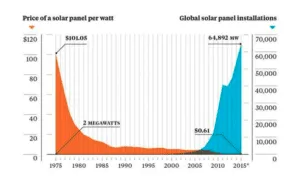
Since 1975, the price of solar panels has dropped by more than 99%. This is a huge, steep drop in comparison to the price changes (or the lack of it) for many other commodities. But what is more important and relevant for us, is the latter portion of the graph, where around 2010, the price starts dipping even steeper and becomes nearly invisible as compared to the earlier prices. This part of the graph – the last 5-10 years have seen a staggering 70% drop in the prices of solar panels.

This part is also exactly where the other graph – of installations, shoots up, and never stops. Today, solar is at an all-time high as far as the demand is concerned and the prices are an all-time low. 
Speaking specifically of Canada, one of the major factors that has driven the growth of solar energy recently is the constantly increasing and constantly high prices of grid electricity.
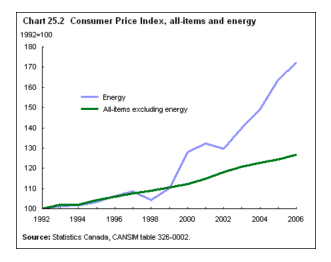
Households spend an extremely large amount of money over 20-30 years on electricity bills, which can be avoided by using nearly maintenance-free solar rooftop systems. The same goes for industrial/commercial facilities that spend millions of dollars in many cases, over the lifetime of a possible solar power system.

If that is not enough, federal and provincial governments have a variety of policies and programs in place to promote the use of solar energy, from the view of making a cleaner, more sustainable Canada. This includes crucial programs like net-metering, direct as well as tax incentives, and carbon credit generation and trading, in some provinces.

Thanks to the above multiple factors, many people believe that the era of solar energy might have just arrived in Canada, and is here to stay.


Filed underCommercial SolarMarket Trends

Frequently asked questions

Yes — commercial and industrial solar installations in Canada have grown substantially over the past five years, driven by falling system costs, improving project economics relative to rising utility rates, and expanded federal incentive programmes including the Clean Technology Investment Tax Credit. Ontario, Alberta, and British Columbia have the largest commercial solar installed bases, though the sector is growing across all provinces with adequate utility rates and regulatory frameworks.
The most significant recent policy driver is the federal Clean Technology Investment Tax Credit — a refundable credit of up to 30% of eligible solar and storage capital costs, enacted as part of Canada's clean economy investment framework. This programme substantially reduces the net capital cost of commercial solar projects and has improved project economics across all sectors. Provincial programmes, including Ontario's IESO saveONenergy Retrofit Incentive Program, provide additional project-level funding for qualifying efficiency and generation measures.
Commercial solar installed costs in Canada have fallen by more than 60% over the past decade, driven by global manufacturing scale increases and improvements in panel efficiency. Module prices — which are set globally — have fallen dramatically; balance-of-system and labour costs have declined more moderately. The net effect is that commercial solar projects that were marginal at $2.50/W a decade ago are now financially compelling at $1.00–$2.00/W before incentives, and increasingly so after the Clean Technology Investment Tax Credit is applied.
Businesses that act now benefit from current federal incentive programmes that have defined envelopes and may be modified by future policy decisions. Project economics are favourable: payback on completed Canadian commercial projects runs 4.6–7.6 years, with an IRR of 15–21%. Electricity rates in most Canadian provinces have increased year-over-year, meaning the savings from solar become more valuable with each passing year. Waiting does not improve a project's financial case — current incentive availability, current installation costs, and current utility rates are the variables that determine today's return.

More from Market & Technology

View all articles