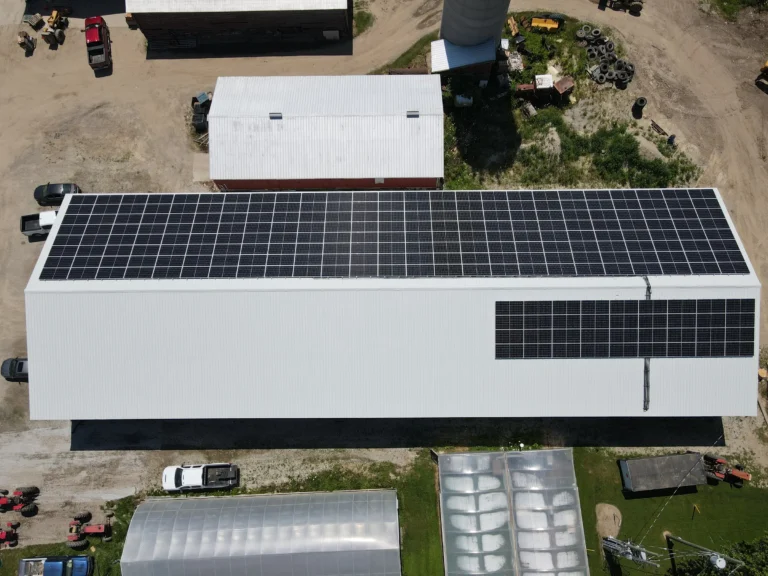
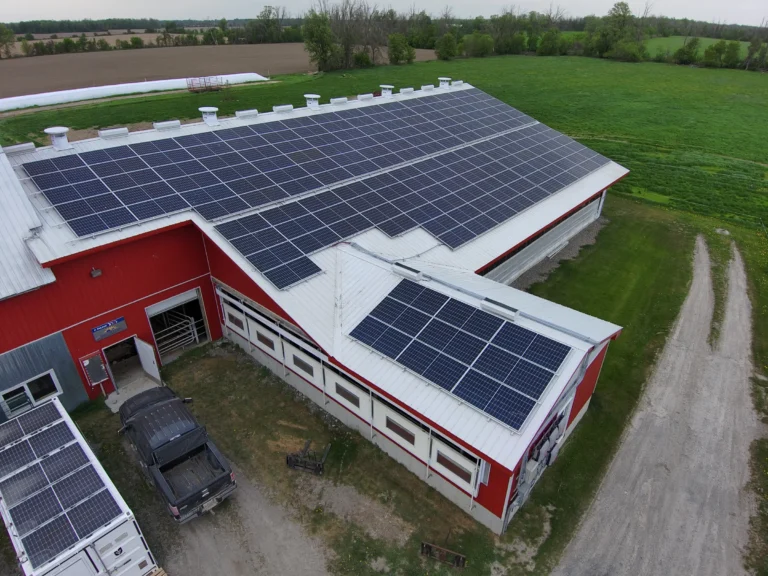
79.6 kW barn-roof solar offsetting 82% of electricity at a dairy farm in Osgoode, Ontario
Osgoode, ON · 2023
82.03%
Annual offset
79.6 kW DC
System size
Commercial solar and battery energy storage can help Canadian farms and agribusinesses reduce electricity costs, manage peak demand and improve operational resilience. The right solution depends on the facility’s electricity profile, available roof or land area, utility rate structure and operating requirements.
Agribusiness solar projects are becoming increasingly important as Canadian agricultural operations look for predictable long-term electricity costs. Irrigation pumps, ventilation systems, refrigeration, grain drying, processing equipment and controlled-environment operations can create substantial and sometimes highly seasonal electricity demand.
Canadian farms and agribusinesses may also face limited local grid capacity, changing electricity costs and operational consequences when critical equipment loses power. Commercial solar can offset electricity purchased from the grid during daylight hours, while battery storage may help manage demand peaks, shift energy use and support selected loads when properly designed.
The question is no longer whether solar works for agriculture. The question is whether it improves the economics of a specific operation.
For many agricultural businesses, the opportunity is not simply generating electricity—it is reducing long-term operating costs while improving resilience against future electricity price increases.
Many Canadian agricultural operations share characteristics that make them strong candidates for commercial solar, including significant daytime electricity consumption, large roof areas or available land, long-term facility ownership and predictable operating schedules.
Agricultural Manufacturing Facilities: Solar can offset a portion of the electricity used by production equipment, ventilation, compressed air, material handling and other daytime loads.
Retail and Equipment Outlets: Dealerships, farm supply stores and distribution facilities may have large roofs and predictable daytime operating schedules that align well with solar generation.
Agtech and Controlled-Environment Operations: Greenhouses, indoor growing facilities and agricultural technology businesses may have significant electrical loads, but system design must account for their operating schedules and seasonal consumption.
Agricultural Services: Cold storage, packing, maintenance, logistics and other agricultural service facilities may use solar to reduce grid purchases associated with regular operating loads.
The potential result is lower grid electricity consumption, improved long-term cost visibility and an energy asset designed around the operation’s actual requirements.
Many agricultural operations are located in areas where electrical capacity is constrained or where expanding service can be costly and time-consuming. Onsite generation does not eliminate dependence on the grid, but it can reduce the amount of electricity purchased during solar-producing hours and help a facility make better use of its existing electrical infrastructure.
The value of solar is therefore determined not only by annual energy production, but by when that energy is generated and how much of it the operation can consume onsite.
Commercial solar reduces electricity purchases when the facility is consuming electricity at the same time the system is generating. For agribusinesses with substantial daytime loads, this can create meaningful long-term savings and reduce exposure to future electricity-price increases.
Project economics should be based on interval electricity data, applicable utility rates, expected solar production, system degradation, operating costs and the amount of generation that can be used onsite.
Available government incentives and utility programs can also influence project economics, although eligibility varies by province, technology and application. Funding opportunities change regularly and should be evaluated alongside project economics rather than driving the investment decision.
Onsite solar can reduce the amount of grid electricity an agribusiness purchases. Where the applicable electricity grid carries associated emissions, this may reduce the operation’s reported Scope 2 greenhouse gas emissions.
For food processors, retailers and export-focused agricultural businesses, documented energy performance is becoming increasingly important within supply chains. Onsite solar provides measurable operational data that can support customer reporting requirements alongside internal sustainability objectives.
Battery energy storage serves a different purpose from solar generation. Depending on the facility and utility rate structure, a battery may be used to reduce short-duration demand peaks, shift solar generation into later operating periods, manage facility loads or support selected critical equipment.
Battery storage does not automatically provide backup power. Backup capability requires suitable equipment, controls, electrical isolation and a defined critical-load strategy. The business case should therefore identify the intended battery application before determining system capacity.
Storage is most likely to warrant further evaluation where an agribusiness has:
In many agricultural applications, solar alone provides the strongest financial return. Battery storage should solve a specific operational or electrical challenge rather than be included by default.
Solar may be suitable where an agricultural operation has consistent electricity consumption, sufficient roof or land area, appropriate electrical infrastructure and a long-term interest in controlling energy costs. Battery storage requires a separate assessment because its value depends on the specific operational problem it is intended to solve.
Every agricultural operation uses electricity differently. A proper assessment should begin with interval electricity data, facility operating schedules, site conditions and future expansion plans before determining the appropriate combination of onsite generation and storage.
Related questions covering planning, technology, and incentives.