Commercial Solar + Battery Storage: When Does Combining Them Create More Value?
Solar and battery storage are separate investments with separate business cases. Learn when combining them creates more value for a commercial facility, and how to compare solar-only, battery-only and solar + battery.
Solar and battery are often discussed as a package. While they can be installed as a package in certain cases, they are both separate investments with separate business cases. For a commercial facility, the important question isn’t whether they should install both solar and battery, but which combination of technologies (including but not limited to these two), creates the strongest business case.
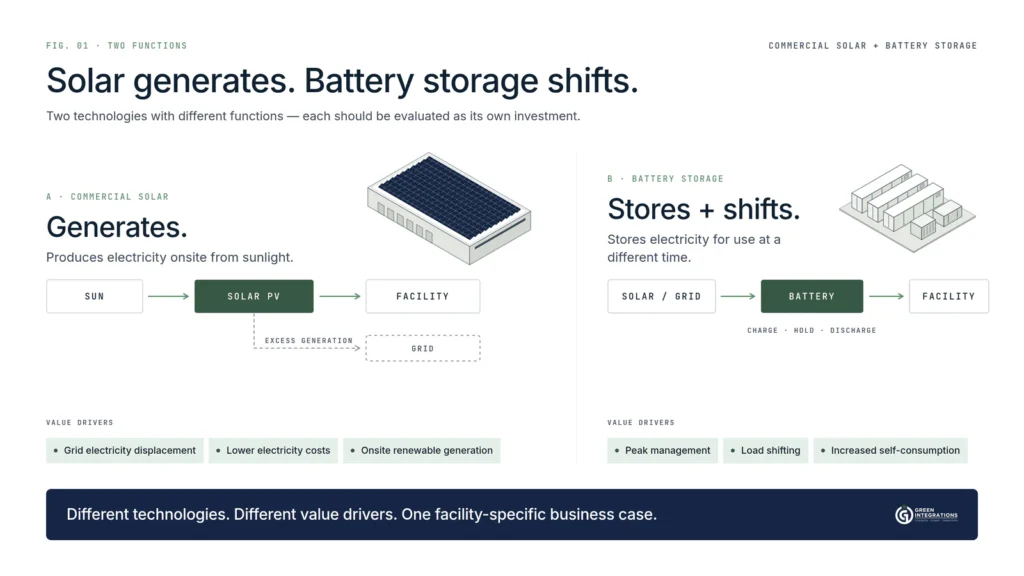
Solar and Battery Storage Perform Different Jobs
Solar generates electricity; battery storage shifts when it is used. In a solar battery storage project, each should be evaluated as its own investment.
Despite being frequently used in the same sentence, solar and battery are entirely different technologies with totally different roles. Solar panels generate electricity from sunlight, while batteries store electricity from solar and/or the grid for later use.
Solar is, therefore, a “source” of electricity, which batteries aren’t. Batteries offer control over the timing of the use of electricity.
The primary purpose of installing solar panels is to generate low-cost, clean electricity that will reduce the facility’s energy bills and possibly support its sustainability goals. The main goal(s) of batteries can be one or more of these:
Why Commercial Solar Can Create a Strong Business Case Without Storage
While batteries are seeing increasing popularity in residential solar systems, a vast majority of commercial facilities still find a solar-only solution sufficient for their needs. The case rests on three strengths:
Direct Generation and Savings: Every kWh produced on site with solar is a kWh of grid power you did not have to buy; and excess generation exported to the grid is also valued under the applicable net-metering or export arrangement. Plus, daytime facility electric consumption generally lines up well with solar generation hours. In short, when solar works, it definitely reduces electric bills, whereas savings from batteries are more complex than that.
Long Asset Life: Solar panel systems are surprisingly durable. Most panels come with 25 or 30-year warranties, while much of the supporting equipment also lasts significantly long and requires minimal maintenance or upgrades. For batteries, the above is not true to the same degree.
Predictable Production Modelling: The energy production from solar is predictable with a fair amount of accuracy, thanks to advanced modelling software and ample meteorological data. This translates to predictable financial impact. With batteries, there are other variables at play that may or may not be in the facility’s control, which typically makes solar a preferred, primary choice.
What Can Battery Storage Add to a Solar Strategy?
Depending on the facility’s load profile, location, and other parameters, batteries can work with solar to offer one or more of the following benefits:
Store excess onsite generation: Storing excess solar energy generated during the day instead of exporting it to the grid may improve savings through increased self-consumption.
Support resilience: Battery storage can offer backup power during periods of grid outages. Note that this benefit is real but is often hard to put a dollar figure on, so weigh it separately from the financial case.
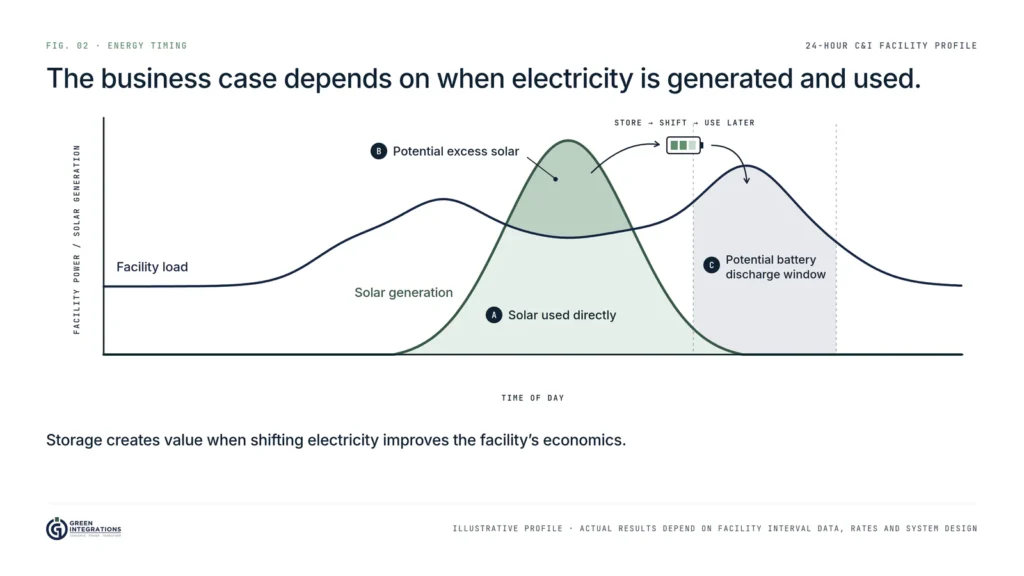
Illustrative 24-hour profile: when solar output exceeds facility load, commercial battery storage can capture the surplus and discharge it during a later peak.
Solar production profile: When and how much the solar array generates across the day and year.
Load profile: What times and how much electricity the facility consumes, and how that matches with the solar production profile.
Export levels: How much excess energy is generated on a daily/annual basis, and how much of it will be exported to the grid, i.e. how much storage does solar actually need.
Export compensation: How the utility credits exported power (net metering, export credits or wholesale-based rates). If exports are credited near retail rates, storing them adds little.
Variation in electricity rates: How widely do rates vary throughout the day? The wider the price gap between hours, the greater the potential savings with batteries.
Demand charges: What percentage of the bill is driven by short peaks in power draw.
Battery specs: What power rating (kW) would the battery need to have to meet the peaks that matter. What energy capacity (kWh) would the battery need to keep powering the facility during the above-mentioned peaks.
Cycling strategy: How often and how deeply the battery is charged and discharged, which affects both revenue and degradation.
Efficiency, degradation and warranty: Round-trip efficiency (typically around 85 to 90 percent), capacity fade over time, replacement timing, and warranty throughput limits.
When combining solar with batteries, the analysis is always comparative: the question is not what the battery saves in isolation, but how much additional value it creates beyond what solar alone delivers.
Why Adding a Battery Does Not Automatically Improve Every Solar Project
You could have the world’s highest-rated battery designed and installed with the highest level of precision, and yet find it to be a poor investment because of a slew of other factors.
A battery can only improve a solar project if it creates significant additional savings through increased self-consumption, peak shavings, load shifting, and utility programs. Here are some common reasons a battery fails to improve a solar project:
Solar and load already match: If most consumption happens in daylight, there is little surplus to store.
Modest demand charges or flat rates: Without a meaningful price spread or peak charge, there is little to shave or shift.
Generous export credits: If exports earn close to retail value, storing them gains little.
Efficiency losses and degradation: Round-trip losses and capacity fade may not justify a narrow rate spread.
Site constraints: Space, fire-code and interconnection requirements can add cost or rule out the project.
The incremental value from the battery has to justify the incremental investment.
Solar-Only, Battery-Only or Solar + Battery?
Option
When it makes the most sense
Solar only
Mostly daytime load, manageable export, low potential for savings through peak shaving or load shifting
Significant demand charges, wide price spreads, resilience needs, or program revenue
Solar + Battery
Non-aligned solar production and load consumption profiles, high demand charges or time-of-use rates, or availability of utility programs
How Businesses Should Compare the Three Options
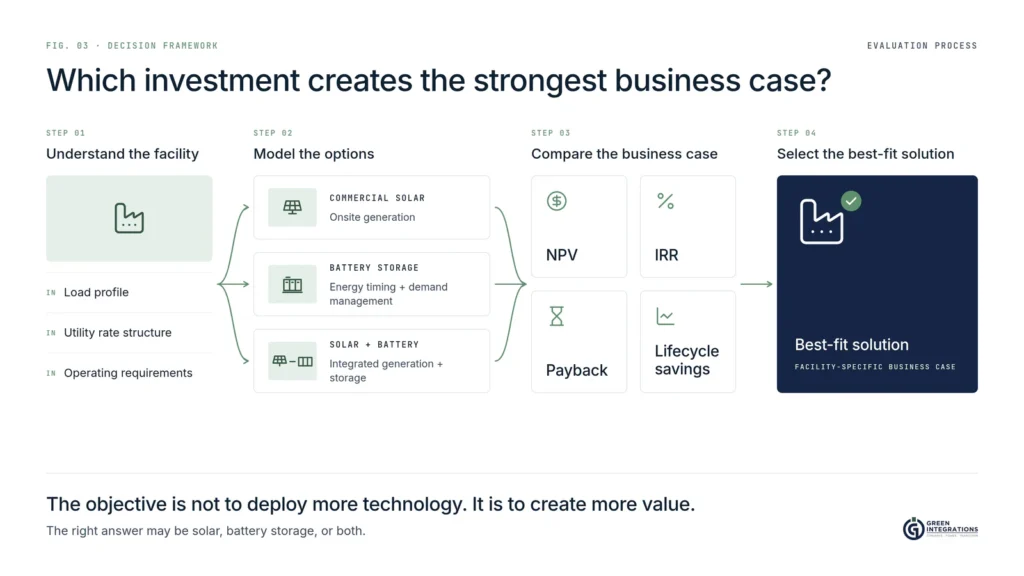
To compare the above three options fairly, we can use the same approach that we discussed in our article about including energy in your capital planning. Here are a few terms to consider:
Return Metrics
NPV (Net Present Value): The value of each option in today’s dollars after accounting for cost and timing.
IRR (Internal Rate of Return): The rate of return each option earns on the capital invested.
Payback period: The time required for cumulative savings or net cash inflows to recover the initial investment.
Inputs and Risk Factors
Lifecycle savings: Cumulative savings over the full operational life of the assets.
Operating benefit: Ongoing, recurring savings or earnings, such as bill reductions, demand savings, and any program or market revenue.
Incentives: Any available programs that reduce the capital cost or improve returns.
Risk: Uncertainty in production, rates, degradation, program rules, and future market conditions.
Evaluate the business case before selecting the technology: the best fit may be solar, battery storage or both.
Use the above metrics and compare each option side by side. Also run the increment: what does the solar + battery case earn beyond solar only? That single comparison often shows whether the battery belongs in the project.
Looking at the Bigger Picture
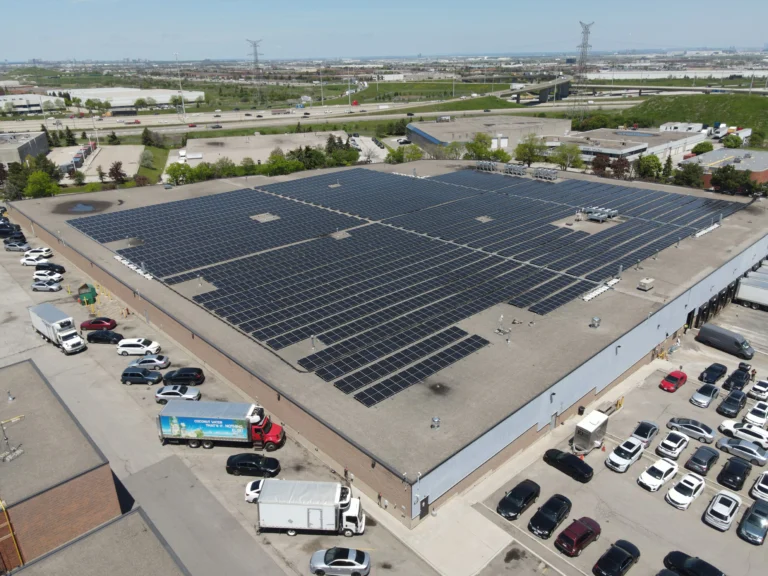
At Green Integrations, we evaluate the usability of any technology as part of a more holistic, energy efficiency approach. For example, in our recent assessment of a GTA-based warehousing facility, we conducted a thorough energy audit and meticulously explored multiple energy efficiency measures alongside solar PV and battery storage opportunities.
Ultimately, our engineering assessment showed solar PV to be a stronger opportunity than the battery storage option evaluated, and identified potential savings from energy-efficiency measures and solar. In other words, we identified the combination of technologies that created the strongest value for the facility – an approach that offers the most optimized savings.
Filed underBattery StorageCapital PlanningCommercial SolarElectricity PricingReturn on Investment
From Our Knowledge Centre
Related questions covering planning, technology, and incentives.
To provide the best experiences, we use technologies like cookies to store and/or access device information. Consenting to these technologies will allow us to process data such as browsing behavior or unique IDs on this site. Not consenting or withdrawing consent, may adversely affect certain features and functions.
Functional
Always active
The technical storage or access is strictly necessary for the legitimate purpose of enabling the use of a specific service explicitly requested by the subscriber or user, or for the sole purpose of carrying out the transmission of a communication over an electronic communications network.
Preferences
The technical storage or access is necessary for the legitimate purpose of storing preferences that are not requested by the subscriber or user.
Statistics
The technical storage or access that is used exclusively for statistical purposes.The technical storage or access that is used exclusively for anonymous statistical purposes. Without a subpoena, voluntary compliance on the part of your Internet Service Provider, or additional records from a third party, information stored or retrieved for this purpose alone cannot usually be used to identify you.
Marketing
The technical storage or access is required to create user profiles to send advertising, or to track the user on a website or across several websites for similar marketing purposes.