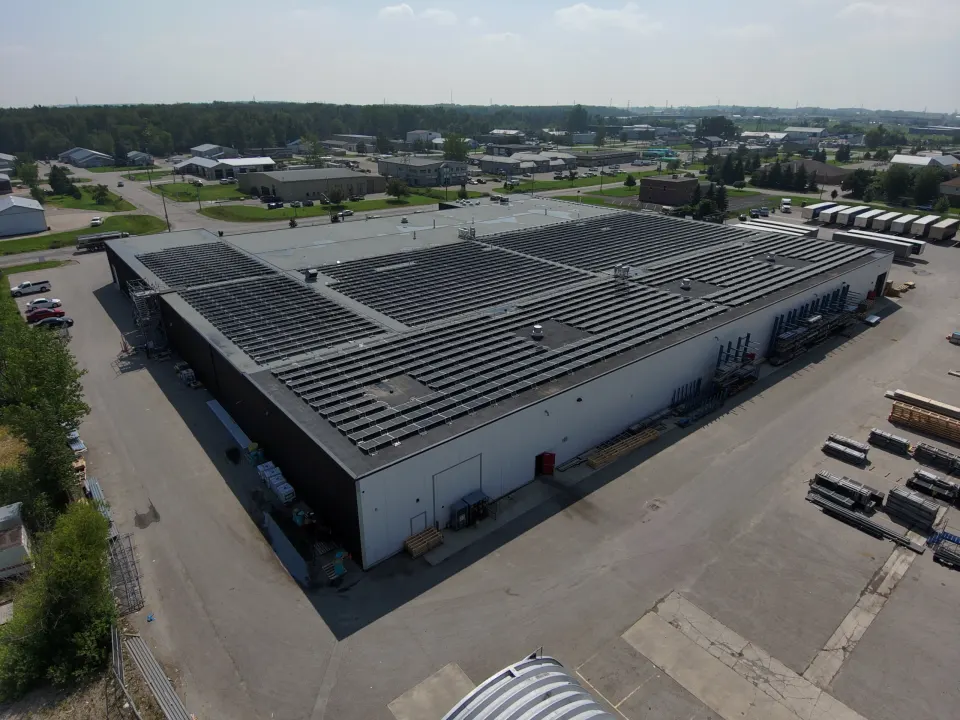
Ce De Candy
- 99.6%
- of annual electricity offset
- 1,142,549 kWh
- a year
- 966 kW DC
- system size
Choose your province, then enter your annual electricity use in kWh from your utility bills, or your average monthly electricity bill if you do not have it, and your building’s square footage. The calculator compares your annual consumption with what your roof can produce and shows how much of that consumption solar covers.
Your estimate shows:
The calculator works out two sizes and recommends the smaller one: the system that offsets your annual consumption and the system your roof can hold. The annual generation of that system, compared with your consumption, gives the share of your electricity solar offsets.
Annual electricity consumption is taken directly from the facility’s utility data where available. If only electricity spend is entered, the calculator provides a preliminary screening estimate because commercial electricity bills can include energy, demand, delivery and fixed charges that vary by utility and rate class. In that case it divides the annual bill by the calculator’s rate assumption for your province: a facility in Ontario paying $12,000 a month comes to about 1.2 million kWh a year at 12¢. Dividing that by the solar yield of 1,150 kWh per kW gives about 1,040 kW DC for a full offset. Because the blended rate on a commercial bill, with demand charges included, can be well above the energy rate, the kWh on your utility bills replace this screening figure in the site-specific analysis.
As a screening assumption, the calculator allows 20 W of solar per square foot of building, with an 85% roof derate, so a 15,000 sq ft building comes to about 255 kW DC. Usable capacity on a real roof depends on roof geometry, mechanical equipment, fire and access setbacks, structural capacity and shading, which the site assessment confirms.
A roof limit is never rounded up: in the example, the roof limits the system to a preliminary 255 kW DC, which produces about 293,000 kWh a year, or about 24% of the facility’s 1.2 million kWh. The AC size is the DC size divided by 1.5, a design assumption of the calculator, so 255 kW DC becomes 170 kW AC. On completed Green Integrations projects the DC to AC ratio has ranged from about 1.26 to 1.5, and the final ratio is set in design around module and inverter counts, load, roof and interconnection. Projects above 1,000 kW AC get a custom quote from a specialist.
The calculator uses one solar yield and one commercial electricity rate per province as screening assumptions. Actual yield varies with location and orientation, and commercial rates vary by utility, rate class, demand profile and facility, so the site-specific analysis works from your site and your own utility bills.
| Province | Solar yield assumption (kWh per kW DC per year) | Electricity rate assumption (per kWh) | Grid electricity intensity, ECCC 2026 (kg CO₂e per kWh) | Provincial program |
|---|---|---|---|---|
| Nova Scotia | 1,200 | 17¢ | 0.581 | Efficiency Nova Scotia Business Energy Rebates: solar measures, pre-approval required |
| Alberta | 1,350 | 14¢ | 0.438 | Emissions Reduction Alberta SEMI program: eligible industrial and manufacturing facilities, currently on waitlists |
| Ontario | 1,150 | 12¢ | 0.059 | Save on Energy Retrofit Program: $770 per kW AC for load displacement, pre-approval required |
Green Integrations also designs and installs commercial solar in British Columbia. For a facility there, talk to a specialist for an estimate.
Public Canadian benchmarks based on 2024 market data put installed commercial rooftop solar at about $1.90 to $2.40 per W DC for systems of 100 to 250 kW DC, and larger systems can cost less per watt. Roof type and condition, interconnection requirements and installation complexity set the final figure. For prices by system size, see what commercial solar costs in Canada, and for Ontario figures, the cost of commercial solar in Ontario.
Qualifying commercial solar equipment may be eligible for the federal Clean Technology Investment Tax Credit of up to 30% of eligible capital costs. The applicable rate depends on claimant, property and labour-requirement eligibility; where the labour requirements are not elected into, the current rate is reduced from 30% to 20%. Qualifying Class 43.1 clean-energy equipment may also be eligible for a 100% first-year CCA deduction under current immediate-expensing rules for property available for use before 2030. CCA is a tax deduction rather than a cash rebate, and its value depends on the taxpayer’s circumstances. The two are not added together as funding, because the ITC can reduce the capital cost on which CCA is claimed. Tax eligibility should be confirmed with a qualified tax advisor.
In Alberta, the Emissions Reduction Alberta SEMI program funds solar at eligible industrial and manufacturing facilities, at the lesser of set $/W levels or 20% of project cost, up to $250,000 per solar project; all SEMI activities are currently on waitlists and funding is not guaranteed. In Nova Scotia, Efficiency Nova Scotia Business Energy Rebates include solar measures, with pre-approval required. See all commercial energy rebates and incentives in Canada.
As of June 30, 2026, the Save on Energy Retrofit Program pays $770 per kW AC for qualifying solar PV above 10 kW AC and up to 1 MW AC that displaces the facility’s own load. Systems above 1 MW AC can apply, with the incentive capped at 1 MW AC and 50% of eligible project costs. Pre-approval and program eligibility apply: the application goes in before the purchase order for the system is issued. The calculator proposes a load displacement system when the solar covers less than half of your annual consumption: the 170 kW AC system above would qualify for about $131,000.
The calculator values annual generation at your province’s rate assumption: the 293,000 kWh from the example comes to about $35,200 in the first year at 12¢. Actual bill savings depend on demand and fixed charges, export compensation, Ontario’s Global Adjustment and the facility’s load curve, which the site-specific analysis models. The calculator assumes electricity rates rise 4% a year over a 25-year analysis period.
Completed Green Integrations projects pay back in 4.6 to 7.6 years, with an IRR of 15 to 30%. Payback is shortest where the rate and solar yield are high, the system offsets most of the annual load and the project stacks incentives. Ce De Candy in Newmarket has $7.2M in verified lifetime savings across the 11 projects of its solar program. Payment plans let energy savings fund the system from day one.
On-site solar replaces grid electricity, which lowers your Scope 2 emissions. The calculator multiplies annual generation by the 2026 electricity consumption intensity for your province from Environment and Climate Change Canada (ECCC) and shows the result in tonnes of CO₂e a year. In Alberta, the 255 kW system from the example produces about 344,000 kWh a year and avoids about 151 tonnes of CO₂e. Ontario’s grid is mostly low-carbon, so the same system there avoids about 17 tonnes. The equivalents in cars and trees are approximate and for communication only, not formal GHG accounting.
The calculator estimates the energy savings from solar. Peak demand charges are a separate part of the bill, and battery storage is what reduces them; commercial battery projects typically pay back in 4 to 6 years, and storage is modelled only where the load profile and rate class make it pay. Read more about commercial battery storage and whether a battery pays for itself on demand charges alone.
The calculator gives a preliminary estimate. The site-specific analysis turns it into a bankable number:
No-cost utility review. Twelve months of consumption and demand data, and the efficiency measures that lower the load, before a system size is recommended.
Bankable financial model. A system sized to your annual consumption profile, with the federal ITC, provincial programs and financing options.
One team through commissioning. The same project lead manages permitting, installation and commissioning, and supports the system for its operating life.
Facilities that aim to offset most of their annual load often start with an energy audit: a smaller system on an efficient baseline costs less.
Ready to see what solar could do for your facility?
Specialist response within one business day. No commitment required.
It gives a preliminary screening estimate from calculator assumptions: one commercial electricity rate and one solar yield per province, 20 W of solar per square foot of building with an 85% derate, and a 1.5 DC to AC ratio. Your rate class and demand charges, consumption profile, roof geometry, rooftop equipment, setbacks, structure and shading move the result, so the bankable number comes from a site-specific analysis of 12 months of utility data.
Divide your annual electricity use in kWh, from 12 months of utility bills, by the solar yield at your site. At the calculator’s Alberta assumption of 1,350 kWh per kW, a facility using 500,000 kWh a year needs about 370 kW DC to offset it. If the roof holds less, the system covers part of the load.
It depends on how much roof the facility has compared with its annual consumption. Green Integrations projects offset 80% to 99.6% of annual use: Vicwest in Stratford 80.3%, Goodspeeds Manufacturing in Lakeside 97.5% and Ce De Candy in Newmarket 99.6%. The calculator compares the system your roof can hold with the system that would cover your whole consumption and shows the share it offsets.
Public Canadian benchmarks based on 2024 market data put 100 to 250 kW commercial rooftop systems at about $1.90 to $2.40 per W DC, so a 100 kW system costs about $190,000 to $240,000, or about $133,000 to $168,000 after a Clean Technology ITC at the full 30% rate. In Ontario, the Save on Energy Retrofit Program pays $770 per kW AC with pre-approval, about $51,000 for the 67 kW AC of a 100 kW DC system at the calculator’s 1.5 DC to AC ratio, and a provincial incentive can reduce the cost on which the ITC is calculated.
It is a refundable federal tax credit of up to 30% of eligible capital costs, so a business can receive it even in a year with no federal tax payable. For qualifying property through 2033, the rate is 30% where the claimant elects to meet the labour requirements and 20% where it does not, and claimant and property eligibility also apply. Tax eligibility should be confirmed with a qualified tax advisor.
For facilities with steady daytime load, yes. Completed Green Integrations projects pay back in 4.6 to 7.6 years with an IRR of 15 to 30%. The federal Clean Technology ITC of up to 30% and the first-year CCA deduction for Class 43.1 equipment are available in every province, subject to eligibility. Savings for a given facility depend on its rate class, demand charges and load profile, which a site-specific analysis models from 12 months of utility data.
Solar lowers the energy part of the bill, including Global Adjustment for Class B facilities, which pay it per kWh. Demand charges, and Global Adjustment for Class A facilities in Ontario, depend on peaks. A battery system discharges during those peaks, and Class A facilities use it to lower Global Adjustment under the Industrial Conservation Initiative.
Your province, annual kWh or average monthly electricity bill, and building square footage give a first estimate in under two minutes. For a site-specific analysis, have 12 months of utility bills (kWh, demand and rate class), your roof type and age, and the facility address.