Clean Technology Investment Tax Credit, or ITC
Refundable tax creditRefundable credit of up to 30% of capital costs, net of other incentives.
Taxable Canadian corporations; the full rate depends on the prevailing wage and apprenticeship conditions.
Nova Scotia·Commercial and industrial solar
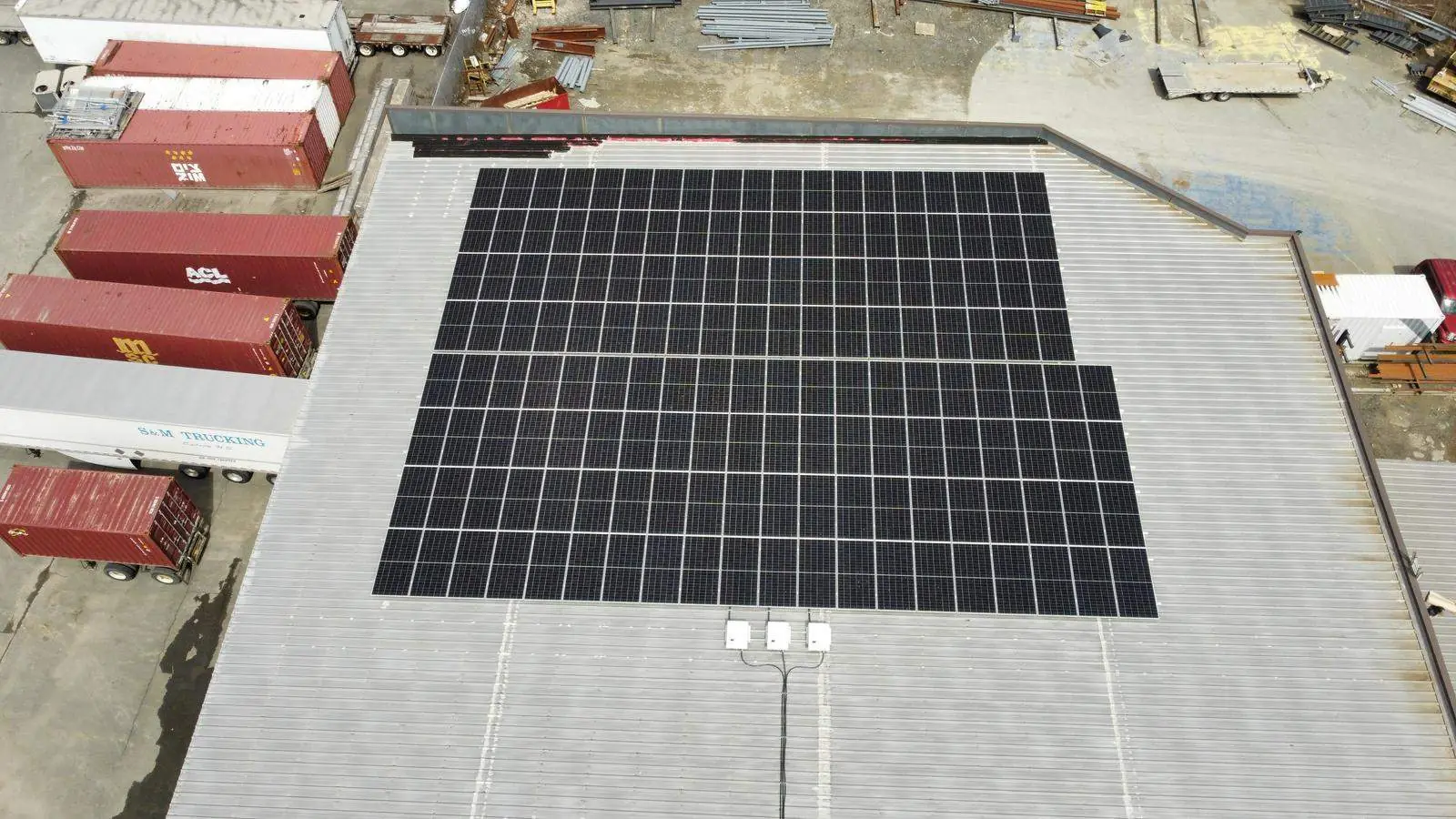
Commercial solar installation in Nova Scotia lets a plant, warehouse or farm generate its own electricity and buy less from Nova Scotia Power. At Goodspeeds Manufacturing in Lakeside, our 90.48 kW DC system offsets 97.53% of annual electricity use. NS Power’s Commercial Net Metering Program credits your generation kWh for kWh against the electricity you buy, up to 1,000 kW AC for a business on a demand rate. Green Integrations installs rooftop solar and battery storage for commercial and industrial buildings across the province.
The work begins with your NS Power bills, and you see the projected payback before you choose a system.
Cost
Commercial rooftop solar in Nova Scotia costs about $1.30 to $2.10 per watt DC installed, before incentives and HST (Harmonized Sales Tax). The larger the system, the lower in that range it usually lands.
If NS Power has to add or upgrade equipment to connect your system, you pay for that work, and the final amount is reconciled against what it actually cost. What moves the price per watt is covered in our guide to what commercial solar panels cost in Canada.
| System size (DC) | Installed cost before incentives | Yearly generation |
|---|---|---|
| 100 kW | $130,000 to $210,000 | 105,000 to 109,000 kWh |
| 200 kW | $260,000 to $420,000 | 210,000 to 218,000 kWh |
| 500 kW | $650,000 to $1,050,000 | 525,000 to 545,000 kWh |
| 1 MW | $1,300,000 to $2,100,000 | 1,050,000 to 1,090,000 kWh |
Net metering
Systems up to 27 kW AC connect through NS Power’s Self-Generating Option. Above that, a business joins the Commercial Net Metering Program, where your rate or your type of operation sets the limit. Limits are in kW AC, the inverter rating, while array size and price are in kW DC. Within the limit the system can meet your expected annual use but cannot exceed it.
| Customer | Limit |
|---|---|
| Rate with a demand charge | 1,000 kW AC |
| Registered farm, registered winery or licensed aquaculture plant | 1,000 kW AC |
| Any other commercial customer | 200 kW AC |
One system can serve several accounts in the same distribution zone if they are registered to the same legal entity and share a non-residential rate code, and you propose how the surplus is split between them. A battery does not count toward your limit, although NS Power includes it when it sets your interconnection class and studies the connection.
Your generation offsets the electricity you use, and anything above that in a billing period is banked in kWh for later bills. Banked credits run until January 1. Whatever is left then is applied to electricity you were billed for in the same calendar year, as a bill credit on your first bill of the new year. Credits beyond that amount are forfeited, and banked credits have no cash value. That is why we size to your annual use, not to your roof.
Incentives
Among the rebates and incentives open to a Nova Scotia business, the federal tax credits are the largest. Efficiency Nova Scotia’s SolarHomes rebate now serves registered non-profits and charities only, after closing to homeowners on April 17, 2025.
Refundable credit of up to 30% of capital costs, net of other incentives.
Taxable Canadian corporations; the full rate depends on the prevailing wage and apprenticeship conditions.
10% of the capital cost of new qualified property.
Sector test, including manufacturing and processing, farming, fishing and logging; refundable only for qualifying corporations, otherwise carried back 3 years or forward 20.
100% write-off in the first year.
Applies to the net cost after rebates and tax credits.
Up to 25% of system costs before HST, to a maximum of $15,000.
Registered non-profits and charities installing grid-tied solar.
The two federal credits work together. In a 2024 technical interpretation the Canada Revenue Agency worked through solar panels powering a Halifax manufacturer, and neither credit reduced the other. The Atlantic credit depends on how the property is used, so we check your sector before it goes into your model. Efficiency Nova Scotia’s Business Energy Rebates offer up to 50% of product costs on energy efficient products, which can help fund efficiency measures evaluated alongside the array.
Payback
Your payback and ROI come from your NS Power rate, because net metering credits count against the electricity you buy, while base and demand charges stay on the bill. The demand charge is set by your highest power draw. These are the business rates in effect from May 1, 2026.
| NS Power rate | Who it fits | Energy charge | Demand charge |
|---|---|---|---|
| Small General (Rate 10) | Under 45,000 kWh a year | 19.804 cents for the first 200 kWh a month, then 17.997 cents | None |
| General Demand (Rate 11) | Over 32,000 kWh a year, demand under 1,800 kW | 15.738 cents for the first 200 kWh per kW of demand, then 12.674 cents | $9.809 per kW |
| Small Industrial (Rate 21) | Industrial use including farming and processing, demand under 225 kW | 14.531 cents for the first 200 kWh per kVA of demand, then 12.215 cents | $7.496 per kVA |
| Medium Industrial (Rate 22) | Industrial use, demand from 225 kW to under 1,800 kW | 11.367 cents | $10.71 per kVA |
| Large General (Rate 12) | Non-industrial use, demand of 1,800 kW and over | 11.78 cents | $11.174 per kVA |
| Large Industrial (Rate 23) | Industrial use, demand of 1,800 kW and over | 11.205 cents | $9.268 per kVA |
On a stepped rate, the first kilowatt-hours you buy each month cost more and the rest cost less. Solar removes the cheaper ones first and reaches the higher step only if your net purchases fall that far. Your average cost per kWh is higher because it includes the demand charge: NS Power’s sample for the General Demand rate is 22.55 cents per kWh at a 20% load factor, meaning a site with sharp peaks, while solar replaces electricity priced at 12.674 to 15.738 cents. We model savings on the energy charge you actually avoid. The wider picture is in our guide to how much a business can save.
A 100 kW DC system at $1.80 per watt on a Small Industrial account, at the full federal credit rate:
105,000 kWh at 12.215 cents.
The first-year write-off on the net cost shortens that payback, and so would any rate increase.
Featured Nova Scotia project
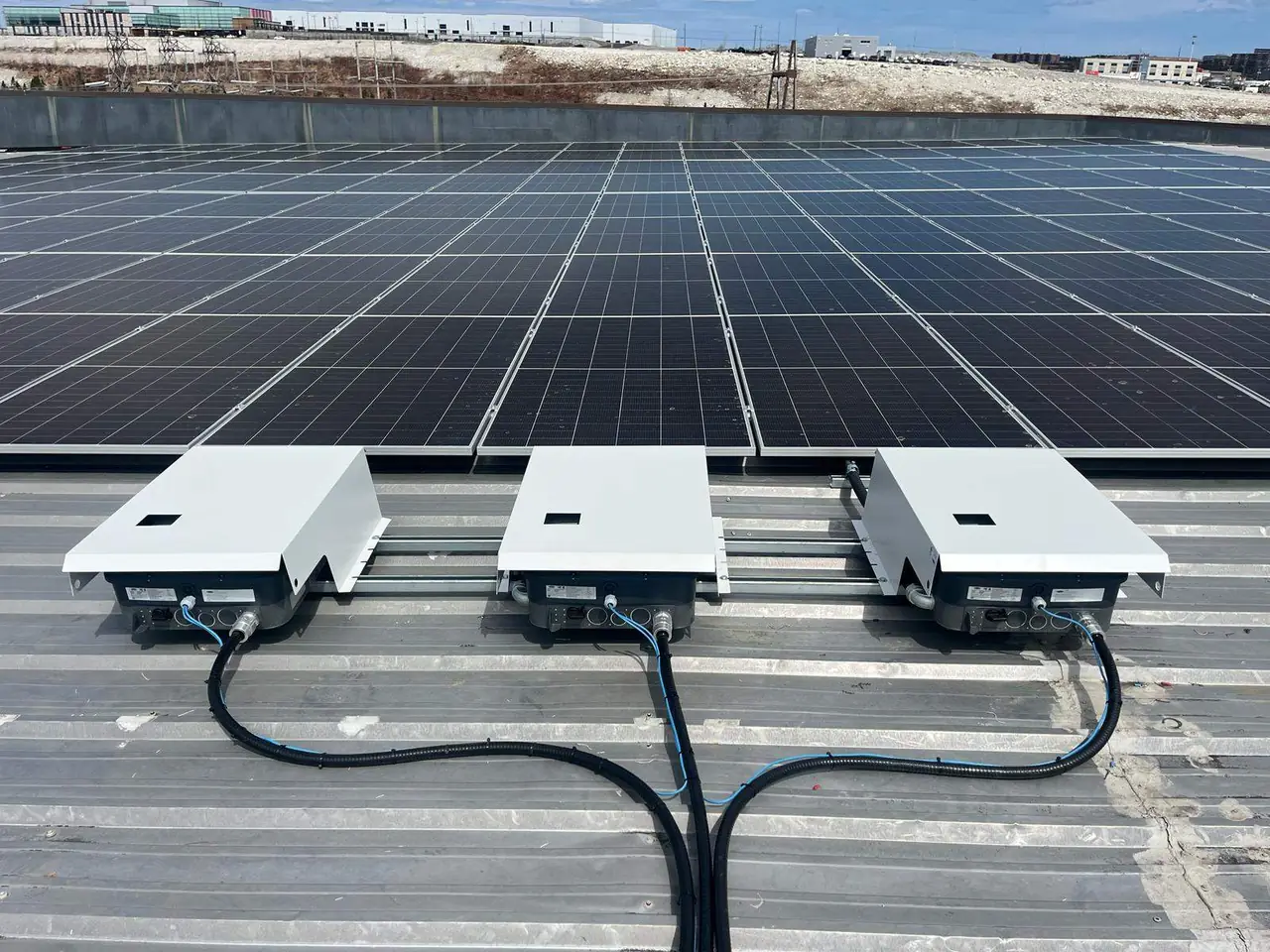
Goodspeeds Manufacturing in Lakeside wanted to rely far less on the grid without disrupting production. We sized the rooftop system to the facility’s annual use rather than oversizing it, mounted it without roof penetrations, and it reached commercial operation on April 25, 2025. See the full Goodspeeds project.
Halifax · Dartmouth · HRM
Commercial and industrial solar panel installation in Halifax, Dartmouth and the rest of the Halifax Regional Municipality follows the NS Power rules above, plus a municipal solar collector permit. The application needs an engineered design showing how the panels connect to the roof, and the final inspection needs proof of a completed NS Power site inspection and electrical permit. Structural changes to a commercial roof call for a Commercial Building Permit.
Truro to Cape Breton
From Truro to Cape Breton, a rural project starts with the electrical service at the site. A system above 27 kW AC on a single-phase circuit needs a Preliminary Assessment, and its results can add technical requirements or restrict capacity, so we check the service before sizing the array. Antigonish, Berwick, Lunenburg, Mahone Bay and Riverport have their own municipal electric utilities. Commercial Net Metering is an NS Power program, so in those towns we confirm the local utility’s terms first.
Storage
Battery storage can reduce the demand charge where your load profile and rate support it, and the Clean Technology ITC covers storage as well as solar.
On Large General and Large Industrial accounts, the billed demand can be the highest reading from the previous December, January or February, so a winter peak can set the charge for months.
Staying on through an outage takes special transfer and isolating equipment, because a grid-connected system otherwise has to disconnect until NS Power has restored service.
Industries
Production equipment, lighting and building systems give a plant a stable electricity profile, which is what the Goodspeeds array was sized against.
Large flat roofs suit commercial solar, and ballasted or mechanically attached racking works with most flat membrane roofs without penetrations.
A registered farm, registered winery or licensed aquaculture plant without a demand charge still qualifies for the full 1,000 kW AC.
Credits land on the account that holds the system, so we settle whether that is the owner or the tenant before design.
Community halls, legions, religious institutions and other groups on NS Power’s Charitable rate pay 19.128 cents per kWh, so a kWh of solar saves more than on any demand rate in the table. In Halifax, Solar City, the municipality’s financing program, offers non-profits, places of worship, co-operatives and charities 10-year financing at a fixed 4.75%.
Process
Four stages, with the NS Power application built in.
We read your bills and interval data (your meter’s readings through the day) to find the rate class, the system size and the savings, at no cost to you. You get an annual production model and a capital plan with incentives and financing built in. An energy audit can add efficiency measures to that plan, so the array is sized to the load you expect to have.
We complete the structural, electrical, permitting and utility deliverables, and the system size sets the path. Class 1 covers more than 27 kW up to 100 kW AC. It starts with an Interconnection Request and a $57 plus HST fee, and NS Power reviews your eligibility, equipment and system size. A single-phase site also pays $750 for its Preliminary Assessment. Class 2 covers more than 100 kW up to 1,000 kW AC and follows the Distribution Generator Interconnection Procedures: a $750 non-refundable study fee, a Preliminary Assessment within 30 calendar days, then a Distribution System Impact Study with a $10,000 deposit.
The electrical contractor on your project obtains a wiring permit and submits electrical plans to NS Power before installation begins, and the work is planned around your production. Once inspections pass and your agreements with NS Power are signed, NS Power clears the connection and may witness commissioning. If your meter cannot measure in both directions, NS Power replaces it at no cost.
Reports at 6 and 12 months compare output with your model, solar maintenance keeps the system producing, and your engineer stays with the project through year 25.
FAQs
Not covered here? A 20-minute call with an engineer usually answers it.
Yes, as long as a facility has steady electricity use through the year. More Nova Scotia businesses are making that call. NS Power counted 99 new commercial solar installations in 2025, up 41% from 2024.
Plan for about 1,050 to 1,090 kWh a year for each kW DC. The lower figure comes from our Goodspeeds system and the higher one from our article on solar potential by province. Shading, tilt and orientation decide the number for your roof.
Yes. Output falls in the darker months and snow can sit on the panels for a time, and annual production figures already include both.
Net metering credits count against energy charges, not demand charges. Solar can still lower billed demand if the peak lands in daylight hours. A later peak may replace it, and a plant on continuous shifts may see little change. Your interval data shows which applies.
Not in every case. Membrane condition, structural capacity and remaining warranty life are all part of the assessment, and a roof close to replacement is better done first, so the array does not have to come off later.
The work is scheduled around your production, and keeping production running was part of the brief at Goodspeeds Manufacturing in Lakeside. Installation takes a few days on a smaller system and several weeks on a larger one.
Our models run for 30 years, and panels are typically warranted to year 30. String inverters need replacing after 12 to 15 years, so that cost is built in from the start.
Expect 6 to 12 months from first assessment to commissioning. Class 2 studies follow NS Power’s study calendar, so a larger project applies early.
Yes, with the legal right to install. NS Power accepts a customer who owns the premises or holds valid legal rights to them, so the landlord’s agreement comes first, and the lease term should outlast the payback.
Your capital plan compares two scenarios with incentives and financing built in, so you can weigh them before you commit capital. Our flexible financing options let you fund a project through the savings it generates.
Ask which price per kWh the savings use, and whether it comes from your rate or from an average of your bill. Then ask who handles the NS Power application and who maintains the array in the years after. On our projects, one team assesses, designs, engineers, installs and operates the system.
We will come back with the system size, the net metering class and a projected payback for your facility, at no cost.